

Building a Keripik Singkong Factory from Empty Land in Lampung
Project Snapshot
This was our first true turnkey cassava project in Sumatra — meaning we did not just ship equipment, we delivered a working factory. Land survey, layout drawings, MEP design, equipment, installation, HACCP documentation support, operator hiring assistance, and 60-day production hand-holding were all under one contract. Below is the project card, finalized in March 2025 when the line passed its 30-day acceptance run.
| Barang | Detail |
|---|---|
| Client | An agribusiness group (4 founding partners, Bu Ratna as managing director) based in Bandar Lampung, Lampung Province |
| Product | Keripik singkong — sliced cassava chips, salted and bumbu balado flavors, 60g and 200g bags |
| Kapasitas | 500 kg/h finished chips, designed for 2 shifts × 7 hours |
| Raw material | Fresh cassava (Manihot esculenta, varieties UJ-3 and Adira-4) from local petani groups in kabupaten Pesawaran and kabupaten Tanggamus |
| Project mode | Turnkey / EPC — civil + utilities + equipment + commissioning + 60-day production support |
| Catu daya | 380V / 3-phase / 50Hz, dedicated PLN connection 197 kVA |
| Workshop area | 620 m² production hall + 180 m² raw material area + 95 m² packaging warehouse |
| Total investment | USD 215,000–235,000 (turnkey scope, excluding land) |
| ROI period | ~17 months, based on partner-reported margin |
| Acceptance run | March 2025 |

Client Background & Why They Came to Us
Lampung produces roughly 6–7 million tons of cassava annually, more than any other Indonesian province. Most of it goes to tapioka (starch) factories — but raw cassava farmgate prices have been brutal for petani over the past few years, sometimes below IDR 1,200/kg, which barely covers harvest cost. Bu Ratna and her three partners come from cassava farming families themselves. Their idea was simple on paper: stop selling at IDR 1,200/kg, start making keripik singkong at IDR 38,000/kg retail, and capture the value chain.
What they did not have: a factory, a process, food safety experience, or any prior equipment knowledge.
They contacted four suppliers — two from China, one from India, and one local Surabaya fabricator. Our quote was the second-most expensive. What won the contract was something specific: during the second video meeting, our application engineer Ms. Yulia walked them through the HCN (hydrogen cyanide) control protocol for bitter cassava, including the soaking parameters, the 2-stage washing scheme, and a sample HACCP plan. The Indian supplier had not mentioned cyanide at all. The Surabaya fabricator had mentioned it but only said “soak overnight, no problem.”
Bu Ratna’s blunt comment during contract signing:
“Pak Wei, I do not know machines. I know cassava. If you understand my cassava, I trust you understand my machine.”
Their three concerns going in were:
- Food safety — they were terrified of a cyanide incident on day 30 of operations destroying the brand before it launched.
- Petani relationships — could the line handle the actual mixed-variety, mixed-size cassava that real Lampung farmers deliver, not the idealized samples in supplier brochures.
- Speed to first revenue — they had borrowed against family land and needed cash flow within 6 months of signing.
Raw Material & End-Product Positioning
Cassava is not potato. The differences matter for every single station of the line.
Fresh cassava roots from Lampung average 600–1,400 g per piece, with thick brown peel and a thin pink-purple secondary skin underneath. The flesh is harder than potato and contains naturally occurring cyanogenic glycosides (linamarin and lotaustralin), which release HCN when the cell walls are broken — slicing, in other words. Sweet cassava varieties typically carry 20–50 mg HCN/kg fresh weight; bitter varieties can hit 200+ mg/kg. Indonesian SNI 01-2997-1996 sets the limit for ready-to-eat cassava products at ≤10 mg HCN/kg, and BPOM enforces this on packaged keripik singkong.
The petani in Pesawaran and Tanggamus deliver mostly UJ-3 (sweet, ~35 mg HCN/kg) and Adira-4 (semi-sweet, ~55 mg HCN/kg). No bitter varieties — Bu Ratna explicitly contracted only sweet-variety farmers. But “sweet” is not zero, so we still designed the line with full HCN reduction capability.
End products were positioned for three channels:
Itu anchor channel was the local Lampung market — toko oleh-oleh (souvenir food shops) targeting domestic tourists who come for Way Kambas elephant park and Krakatau viewpoint trips. 200g family bags at IDR 22,000 retail, bumbu balado and original salt flavors. This channel alone was projected to absorb 40% of capacity.
Itu modern channel was a private-label contract with a Sumatra-region distributor supplying about 280 minimarket outlets across Lampung and South Sumatra. 60g bags, IDR 5,000 retail.
Itu export pilot channel — a small but symbolically important slice — was 5kg bulk bags shipped to a toko Indonesia importer in Jeddah, serving the Indonesian diaspora and Hajj season demand. Roughly 1.5 tons/month at the start.
Slice thickness target was 1.7 mm for the 200g traditional bags (Indonesians prefer slightly thicker, more “bite-feel” keripik singkong) and 1.4 mm for the 60g modern channel.
Process Flow & Equipment Configuration
The cassava line shares some DNA with a potato chips line, but four stations are fundamentally different: the two-stage peeling, the dedicated soaking tank for HCN reduction, the harder-tooth slicer, and the two-stage washing to leach residual cyanogenic compounds.
Equipment list (turnkey scope, simplified from the as-built BOM):
| # | Equipment | Model | Key spec | Kekuatan |
|---|---|---|---|---|
| 1 | Cassava intake hopper + sorting belt | IH-800 | 800 kg buffer, 4-station sorting | 1.5 kW |
| 2 | Drum washer | DW-800 | Inclined drum, mud removal | 3 kW |
| 3 | Brush peeler stage 1 | BP-500 | Removes brown outer peel | 4 kW |
| 4 | Carborundum peeler stage 2 | CP-500 | Removes pink secondary skin | 5.5 kW |
| 5 | Trimming conveyor | TC-500 | 4 stations, manual eye removal | 1.1 kW |
| 6 | Cassava slicer | SL-500C | Tungsten carbide blades, 320 rpm | 4 kW |
| 7 | Soaking tank | ST-1500 | 1,500 L, water exchange every 90 min, food-grade citric acid dosing | 1.5 kW (pump) |
| 8 | Two-stage spray washer | SW-500D | Counter-flow, 1.2 m³/min fresh water | 3 kW |
| 9 | Air-knife dewatering | AK-500 | 4 air knives, 7.5 kW blower | 7.5 kW |
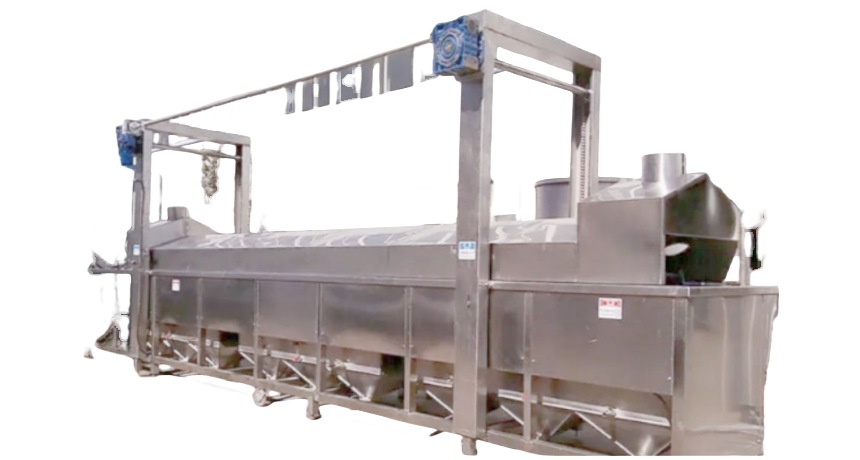
| 10 | Continuous fryer | CF-500G | LPG-fired, oil 1,400 L, 1.6 m × 8 m | 5.5 kW + LPG |
| 11 | Vibration de-oiler | VD-500 | Pre-removes surface oil before centrifuge | 1.5 kW |
| 12 | De-oiling centrifuge | DO-500 | 360 rpm, residual oil ≤20% | 4 kW |
| 13 | Single-drum seasoning | SS-500 | Drum dia 800 mm, oil-spray atomizer | 2.2 kW |
| 14 | Multi-head weigher | MW-14H | 14 heads, ±0.3g | 1.8 kW |
| 15 | VFFS bagger × 2 | VFFS-380 | 60g + 200g lines, 45 packs/min each | 4 kW each |
| 16 | Metal detector + checkweigher | MD-CW | Inline at end of packaging | 0.8 kW |
The soaking tank (#7) is the heart of the HCN control. Water in the tank is exchanged every 90 minutes via overflow, and a small dosing pump adds food-grade citric acid to keep pH at 4.0–4.5 — this accelerates linamarin hydrolysis and improves color stability of the final chips. Sliced cassava sits in this tank for 80–95 minutes before moving to the two-stage spray washer. Combined with the high-temperature frying step (170°C × 3.5 minutes), our validation runs measured residual HCN at 2.1–4.6 mg/kg in finished product, well below the SNI 10 mg/kg limit.
Total connected load is about 51 kW; running load averages 32 kW. The PLN connection at 197 kVA leaves comfortable headroom for the second-shift expansion already planned for 2027.

Layout & On-site Implementation — The Turnkey Scope
Because this was turnkey, our scope started long before the equipment showed up. Here is the actual timeline we ran.
Phase 1 — Site & Design (Aug 2024 – Oct 2024, 9 weeks) We assigned a Mandarin-Indonesian bilingual project engineer, Mr. Arif, to spend 11 days on-site in Bandar Lampung. He surveyed the empty 1,400 m² plot Bu Ratna had bought in kawasan industri Tanjung Bintang, took soil-bearing tests with a local civil consultant, and produced 3D layout drawings. We worked with a local architect (PT Cipta Selaras Lampung) for IMB / PBG permitting because as a foreign EPC contractor we cannot stamp drawings in Indonesia.
Phase 2 — Civil & Utilities (Oct 2024 – Jan 2025, 14 weeks) Foundation, steel-frame factory shell with 6 m clear height, food-grade epoxy floor with 1.5% drainage slope toward central trench, exhaust hood and 12 m stainless stack for the fryer area, PLN 197 kVA dedicated transformer installation, deep well + 4-stage water treatment (Lampung municipal water has periodic turbidity issues we did not want to gamble on), LPG manifold for 24 × 50kg tanks. This phase was managed by our local civil partner with weekly remote oversight from our Qingdao office plus one mid-phase site visit.
Phase 3 — Equipment Shipment & Installation (Jan 2025 – Feb 2025, 7 weeks) Three 40HQ containers from Qingdao to Panjang Port (Lampung’s main port), 26 days at sea. Customs cleared in 9 working days; one container was held for a manual inspection because the soaking tank was an unusual HS code. Inland trucking 18 km to site. Installation took 17 days with two of our engineers (Mr. Liu and Mr. Cheng) plus four local fabricators we trained on stainless welding standards.
Phase 4 — Commissioning & 60-day Production Support (Feb 2025 – Apr 2025) Cold testing, water testing, oil testing, then 7 days of trial production with progressively larger cassava batches. Mr. Liu stayed on-site for 60 days total — significantly longer than typical equipment-only projects — running the line alongside the newly hired local production team and gradually transferring authority. By day 45 the local supervisor Pak Yusuf was running shifts independently; Mr. Liu spent his last 15 days mostly drinking kopi tubruk and writing handover documents.
The biggest unexpected hassle was not technical — it was getting the IMB/PBG building permit, which took 7 weeks longer than the local architect originally promised. We absorbed about USD 9,000 of extended engineer hotel and rebooked flight costs because of this. Lesson written into our standard turnkey contract afterwards: permitting delays beyond 30 days trigger a force-majeure clause shared between client and contractor.
Challenges & Solutions
Challenge 1: Cassava size variability broke the peeler throughput on day 3
The brochure spec for the brush peeler assumed cassava roots in a 400–900 g range. Reality from Lampung petani: deliveries contained pieces from 250 g up to 1,800 g, sometimes with significant curvature. On day 3 of trial production, the brush peeler kept jamming on oversized pieces, and small pieces were under-peeled. Throughput dropped to 320 kg/h, far below the 500 target.
The fix had two parts. First, we installed a manual pre-cutting station before the drum washer where two operators with stainless cleavers chop pieces over 1.2 kg into halves. Yes, it is “low-tech” — it is also the right answer for this raw material reality. Second, we adjusted the brush peeler running speed by 18% (slower = more dwell time) and increased peel-pressure spring tension. Throughput recovered to 480–510 kg/h depending on the batch size distribution. The two pre-cutting operators became permanent positions at IDR 95,000/day each — about USD 380/month combined, which the project economics easily absorbed.
Challenge 2: Color drift between morning and afternoon batches
Within the first 2 weeks of production, Bu Ratna’s QA staff noticed afternoon batches were slightly darker and oilier than morning batches from the same petani delivery. Investigation traced this to the soaking tank water being changed less frequently as the day progressed (operator fatigue), so accumulated starch and sugar in the soaking water raised the Maillard browning during frying.
We installed a low-cost timer-controlled solenoid valve on the tank overflow that triggers automatic water exchange every 75 minutes regardless of operator action, plus a turbidity sensor that triggers an extra exchange if water clarity drops below threshold. Cost added: about USD 850. Color uniformity stabilized within 4 days.
Challenge 3: Cyanide testing logistics
Bu Ratna wanted every batch tested for residual HCN before release — not just the periodic sampling that BPOM technically requires. Sending samples to the BBIA lab in Bogor took 3–5 days, which would have killed the production schedule. The solution was to set up an in-house rapid test station using picrate paper test kits (semi-quantitative, accurate to ±2 mg/kg) for every batch, with formal BBIA-certified lab tests done weekly on composite samples. This satisfied her risk tolerance and the actual BPOM compliance requirement simultaneously. Total monthly cost of the testing program: about IDR 2.4 million, or roughly USD 150.
Challenge 4: HACCP documentation push-back during BPOM registration
When Bu Ratna submitted the HACCP and BPOM-MD registration, the regional BPOM office in Bandar Lampung asked for additional documentation on the soaking tank’s CCP (critical control point) design. The HACCP plan we had drafted listed soaking as a CCP but did not include continuous water exchange data logging. We retrofitted a simple datalogger on the solenoid valve to create a 7-day rolling log, and resubmitted. Approval came through 6 weeks after that — total BPOM-MD turnaround was about 4.5 months from first submission.
Production Data & Client Validation
After the 60-day support period and another 90 days of independent operation, here is what the Lampung line was actually doing as of the last quarterly report Bu Ratna shared in April 2026.
| Metric | Target | Actual (12-month average) |
|---|---|---|
| Output capacity | 500 kg/h | 478 kg/h (95.6%) |
| Yield rate (raw cassava → finished chips) | 31% | 29.8% |
| Residual HCN in finished product | ≤10 mg/kg | 2.1–4.6 mg/kg |
| Oil consumption | 36 L/100kg | 38 L/100kg |
| Operators per shift | 11 | 12 |
| LPG consumption | — | 0.21 kg/kg finished |
| Water consumption (process only) | 4.5 L/kg raw | 4.8 L/kg raw |
| Bag rejection rate | ≤1.8% | 1.4% |
| Monthly output (single shift, 22 days) | ~62 tons | 58–64 tons |
The 95.6% capacity achievement reflects two real factors: peel-loss variability with mixed cassava sizes (we lose 1–2 percentage points of yield to oversized pre-cutting), and the deliberate 12-minute oil filtration cycle every 3 hours which the original spec did not include but Bu Ratna’s QA insisted on.
By month 8, the export pilot to Jeddah had grown from 1.5 tons/month to 4.2 tons/month, and a small order for Brunei (320 kg trial shipment) had also been fulfilled. The modern channel contract had expanded from 280 outlets to 410. Bu Ratna’s most recent message:
“Pak Wei, the line is OK. The petani are happy because we buy at IDR 1,650 now, not 1,200. My daughter quit her bank job in Jakarta to manage marketing. This is more than a factory.”
That kind of comment is why we like turnkey projects — even when they are operationally exhausting.




Investment & ROI Breakdown
The full turnkey budget, broken down based on the as-built reconciliation we did with Bu Ratna’s accountant:
Investment side:
- Equipment FOB Qingdao (3 × 40HQ containers): USD 138,000
- Sea freight + insurance to Panjang Port: USD 11,200
- Inland trucking + customs + bonded handling: USD 5,800
- Installation, commissioning, 60-day on-site support: USD 24,500
- Civil works (factory shell, epoxy, drainage, exhaust): USD 38,000 ≈ IDR 605 million
- PLN transformer + LPG manifold + water treatment: USD 14,000
- Permitting, design fees, BPOM-MD registration support: USD 6,500
- Total turnkey investment: ~USD 238,000 (~IDR 3.78 billion)
Land cost (1,400 m² in kawasan industri Tanjung Bintang) was about IDR 980 million separately, paid by the partners directly.
Operating economics per 60g modern-channel bag:
| Cost component | IDR per bag |
|---|---|
| Raw cassava | 940 |
| Palm oil | 580 |
| Seasoning | 175 |
| Packaging film + N2 | 380 |
| Labor (allocated) | 320 |
| Energy (PLN + LPG + water) | 210 |
| Depreciation (7-year line) | 290 |
| HCN testing & QA | 45 |
| Total cost | ~2,940 |
| Selling price ex-factory to distributor | ~3,950 |
| Gross margin | ~25.6% |
For the 200g traditional-channel bags, gross margin runs higher at roughly 32% because of less expensive packaging per gram and stronger pricing power in the toko oleh-oleh channel.
At an average of 60 tons/month finished chips spread across the three channels, monthly gross profit lands around IDR 220–260 million. The payback period works out to roughly 16–18 months on the turnkey investment — slower than a comparable 300kg/h potato line because of higher upfront civil and permitting costs, but with a higher long-term ceiling because the partners locked in cassava supply at favorable terms with the petani cooperative.
Bu Ratna’s group has already drawn up a Phase 2 plan to add a parallel stick-cut cassava line (for singkong stik / cassava fries) in 2027 using the same factory shell — civil work for that expansion is already pre-engineered into the existing layout, which is one of the under-appreciated benefits of doing turnkey from day one.
After-sales & Ongoing Support
The turnkey contract included a 24-month equipment warranty (extended from our standard 12 months because of the EPC scope), a wear-parts kit covering 18 months of normal operation, and dedicated remote support through a 4-engineer WhatsApp group available 14 hours/day across Indonesian time zones.
We hold 62 commonly-needed spare parts for cassava lines in our Surabaya agent’s warehouse. Average replenishment time to Lampung is 2–4 days by overland + ferry via Bakauheni. Air-freight from China remains an option for emergency parts at 5–7 day delivery.
Beyond reactive support, we built three proactive programs into the turnkey scope:
- Monthly remote video walk-through for the first 12 months — Mr. Arif, our project engineer, joins by WhatsApp video and walks the line with Pak Yusuf to spot wear and parameter drift.
- Quarterly process audit including a residual HCN spot test from our side using sealed samples.
- Annual on-site visit by one of our engineers, paid by the client at cost (typically USD 1,500–2,000 plus travel).
In December 2025 Bu Ratna placed a follow-on order for a second VFFS bagger (180g format for the export market) and a small bumbu mixing tank — total USD 19,500. Air-freighted in 13 days. We did not need to send an engineer; her team installed it themselves using video guidance, which is a quiet sign that the technology transfer worked.
Related Indonesia Projects
If a turnkey cassava factory is not quite the right fit for your situation, these adjacent case studies on this site may help you calibrate:
- For a fresh potato line at half the capacity and roughly one-third the investment: the 300kg/h fresh potato chips production line in Bandung, West Java
- For a starter-scale entry into chips manufacturing on single-phase power: a 150kg/h small-scale potato chips making machine project in Surabaya
- For Pringles-style stacked chips made from potato flake and cassava starch blends: a compound potato chips line case in Jakarta
- For a fully automated, low-headcount facility: an automatic potato chips manufacturing plant for an Indonesian customer
FAQ + CTA
Cassava roots contain cyanogenic glycosides — primarily linamarin — which release HCN when cell walls are ruptured during peeling and slicing. Sweet varieties grown in Lampung average 30–55 mg HCN/kg fresh weight; bitter varieties can exceed 200 mg/kg. The soaking tank with citric-acid-acidified water (pH 4.0–4.5) for 80–95 minutes hydrolyzes the bulk of the linamarin, the two-stage counter-flow spray wash leaches the HCN-laden liquid, and the 170°C × 3.5-minute fryer step volatilizes the remainder. No single step is enough on its own — it is the combination that gets you reliably under SNI 01-2997-1996’s 10 mg/kg limit. We measured 2.1–4.6 mg/kg in this Lampung project’s finished product.
In our scope: layout design, civil drawing coordination with a local stamped architect, MEP design, equipment supply, sea freight, customs, installation, commissioning, 60-day on-site production support, HACCP plan template, BPOM-MD documentation support, and operator training. It does NOT include: land purchase, IMB/PBG permitting fees (we coordinate, client pays), local labor wages during construction, BPOM registration fees, and ongoing raw material supply contracts. Always read the EPC scope line by line before signing — different suppliers draw the line differently.
Cassava and sweet potato share enough characteristics that the same line can run sweet potato with minor parameter changes (lower frying temperature, no soaking tank required). Taro is technically possible but the carborundum peeler wears faster on taro skins. Banana chips need a dedicated banana slicer (cross-cut, different blade geometry) and a different blanching parameter — possible as an add-on, but not plug-and-play on the existing equipment. Bu Ratna’s Phase 2 plan includes a separate banana chips module rather than retrofitting this line.
The honest answer: with a manual pre-cutting station and acceptance of slightly lower yield. Cassava from real-world Lampung petani is not the uniform size you see in supplier brochures. We design the line with 18–22% throughput buffer specifically to absorb this variability, and we install a 4-station manual sorting/trimming conveyor where 2–3 operators chop oversized pieces and remove damaged ones. Trying to fully automate this would push equipment cost up by USD 60,000+ and only marginally improve yield — for a startup factory, manual handling is the better economics.
BPOM-MD timelines for keripik singkong in 2024–2025 ran 3–6 months depending on completeness of the initial submission and the regional BPOM office’s queue. Our HACCP CCP documentation needed one round of revision (adding water-exchange data logging on the soaking tank), which added about 6 weeks. Plan for 5 months from first submission to MD number in your cash flow model, and start the BPOM process in parallel with civil construction — not after commissioning. Several of our clients lost 60–90 days of revenue by sequencing this serially.
Talk to an Engineer About a 300kg/h Line for Your Market
If you are considering a similar 300kg/h fresh potato chips production line in Indonesia or any other Southeast Asian market, the most useful next step is a 30-minute video call with one of our process engineers. Bring your potato sample data (variety, reducing sugar if available, average size), your target product spec, and your local power and gas situation. We will share the actual parameter card from this West Java project and tell you honestly whether your scenario is closer to Hendra’s, or whether you need a different configuration.
 Indonesian
  English
  Spanish
  French
  Arabic
  Russian
  Portuguese
  German
  Italian
  Malay
Malay  Uzbek
Uzbek