

Frozen French Fries Production Line: A Field-Proven Engineering Guide for Frozen Fresh and Coated Fry Plants
The French Fries Production Line is engineered as a continuous 14-stage process, transforming raw potatoes into finished frozen fries at throughputs from 100 kg per h up to 5000 kg per h. Applying the 80/20 rule, peeling, two-stage blanching, and par-frying collectively determine over 80 percent of final product quality. Each section of the line is designed for reliability, cleaning access, and precise process control, ensuring consistent yield and compliance with demanding export standards.
This article provides a comprehensive resource for technical buyers, project managers, and operations teams. You will find detailed breakdowns of process flow, core equipment selection, automation levels, plant layout, food-safety controls, and CapEx/ROI calculations. The guide addresses key engineering decisions, regulatory benchmarks, and procurement factors that impact performance and long-term value in a Frozen French Fries Production Line investment.
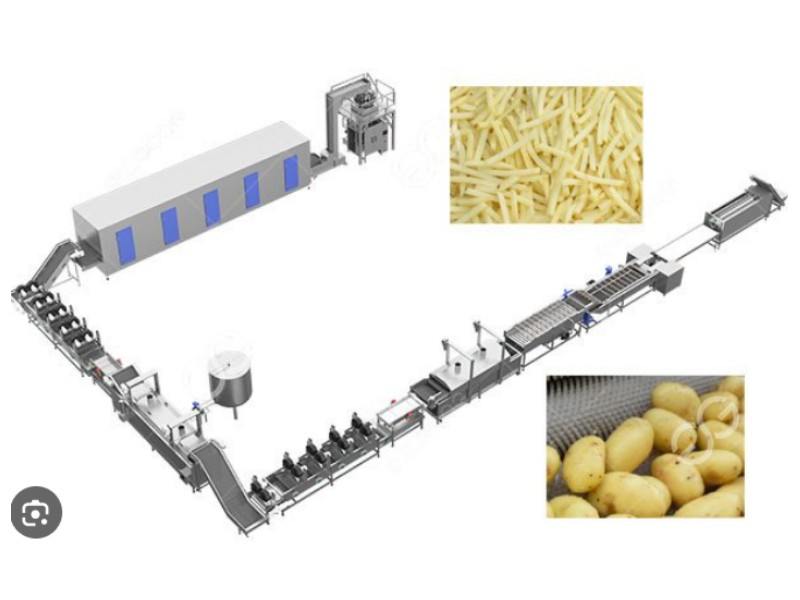
What Is a Frozen French Fries Production Line? Definition, Scope, and Output Tiers
A Frozen French Fries Production Line integrates continuous-flow machines to convert raw potatoes into three main finished formats: frozen par-fried fries (comprising 85% of global output), fresh-cut chilled fries (with 7-10 days shelf life), and fully fried seasoned snack fries in vacuum packs. The typical line features 14 functional stages, includes 9-12 standalone machines, and operates via a centralized PLC + HMI control system.
Output Capacity Tiers and Typical Investment
| Tier | Throughput | Target Buyer | CapEx EXW | Footprint | Crew |
|---|---|---|---|---|---|
| Small Scale | 100-300 kg/h | Local QSR supplier | USD 110k-280k | 200-400 m2 | 6-8 |
| Mid-Range | 500-1000 kg/h | Regional brand | USD 380k-750k | 600-900 m2 | 10-14 |
| Industrial | 1500-2000 kg/h | National brand | USD 1.1M-1.8M | 1200-1800 m2 | 15-20 |
| Large Industrial | 3000+ kg/h | Export-oriented producer | USD 2.5M-5M+ | 2000-2500 m2 | 18-25 |
| Snack/Coated | 100-500 kg/h | Branded snack producer | USD 150k-600k | 300-700 m2 | 8-12 |
Raw-to-finished yield averages 48-52%. Always confirm whether quoted capacity refers to raw input or finished output to avoid procurement errors.
Full Process Flow of a Frozen French Fries Production Line
The 14-stage standard process sequence applies across all capacity tiers. The main differences are in the specific technologies, machine sizes, and automation levels chosen at each step of the line.
Key Operating Windows for a 1000 kg per h Frozen Line
- Steam peeling: 1.0-1.6 MPa saturated steam, peel loss <=8%
- Strip cutting: 6×6 mm or 9×9 mm, hydro-cutting at 3 kg/cm2
- First blanching: 90 deg C x 3-5 minutes (polyphenol oxidase inactivation)
- Second blanching: 60 deg C x 1-2 minutes (color stabilization, SAPP uptake)
- Hot-air drying: 8-10% surface moisture removal
- Par-frying: 175-180 deg C x 50-140 seconds depending on strip thickness
- De-oiling: vibratory + air-knife, target oil content <8% on dry matter
- IQF freezing: -35 deg C chamber, -18 deg C core temperature at exit
The first blanching is set at 90 deg C (not 95 deg C) because above 92 deg C surface starch gelatinizes, causing oil uptake spikes. The second blanching at 60 deg C is the SAPP absorption window, which prevents gray-blue discoloration. These parameters are essential for meeting McDonald specification compliance.
For the Frozen French Fries Production Line, industrial lines above 1500 kg/h introduce optical color sorting at 2 m per s belt speed, and dual-tank blanchers with PID control for time and temperature. This ensures consistent color, texture, and compliance with export standards. Two-stage blanching is crucial for achieving 12-month frozen shelf life and passing EU and US buyer audits.
Core Equipment Breakdown of a Frozen French Fries Production Line
Major equipment specifications scale with output tier, affecting line footprint, utility demand, and payback period.
Peeling: Brush vs Steam
Brush roller peelers suit lines below 500 kg/h (4.5 kW, 9 nylon brush rollers, 12-15% peel loss). Above 1000 kg/h, steam peeling (4-5 t/h raw, 1.0-1.6 MPa, peel loss <=8%) is standard, with a 14-20 month payback from raw material savings.
Strip Cutting: Mechanical vs Hydraulic
Mechanical cutters (7-10 mm adjustable, 200-300 kg/h per unit, 1.5 kW) suffice for small lines. For higher throughputs, hydro-cutting (3 kg/cm2 high-pressure, 6×6/9×9 interchange, 3000-5000 kg/h continuous) is specified for uniformity and labor savings.
Blanching: Single-Stage vs Two-Stage
Small lines use a single electrically-heated blancher (36 kW), while industrial lines employ two-stage steam-heated blanchers with hydraulic belt-lift and inline SAPP dosing. Two-stage design separates 12-month shelf life from 90-day color failure.
Par-Frying: The OpEx Battlefield
- External gas heat exchanger 1.2 million kcal/h, multi-fuel (natural gas/LPG/diesel/heavy oil/methanol)
- Dual coarse filters 500 mm dia, A/B redundant, 12.5 m3/h circulation
- Inline fine filter 80 L/min, 0.3-0.37 MPa, 2 paper filters/day
- Vertical tube oil cooler cuts post-shift cleaning by 60-70%
- Tail scraper, side smoke hood, 5 cm aluminum-silicate insulation
This configuration extends oil life from 3-4 days to 12-15 days, saving USD 180,000-240,000 per year in palm oil cost on a 3000 kg/h line.
IQF Freezing
Mid-range plants use IQF cabinet tunnels (8000x2200x2300 mm, 125 HP semi-hermetic screw compressor, 250 kW installed, +/-2 deg C). Industrial lines specify fluidized-bed tunnels (120-150 mm B1-grade polyurethane, variable-pitch evaporators, 4:1 ammonia or freon circulation).
For the Frozen French Fries Production Line at industrial scale, equipment selection includes steam peeler, hydro-cutter, dual-tank steam blancher, and fluidized-bed tunnel freezer, totaling USD 1.1-1.6M EXW with 3-6 operator SCADA control. This configuration meets export standards and enables 24/7 operation with minimal manual intervention.
Six Engineering Advantages Built Into Our Frozen French Fries Production Line
The following engineering advantages become evident after 12 months of continuous production and real-world OpEx tracking.
1. Dual-Stage Steam-Heated Blanching with Inline SAPP Dosing
Two-tank blanching architecture with independent PID temperature control and SAPP dosing at 0.3-0.5% ensures polyphenol oxidase inactivation and color stabilization.
Result: 12-month frozen shelf life without color drift, acrylamide below EU 500 microgram/kg threshold.
2. 1.2 Million Kcal External Gas Heat Exchanger
External heat source decouples combustion from fryer body, enabling operation on natural gas, LPG, diesel, heavy oil, or methanol, and reducing thermal stress.
Result: 30-40% extended fryer body life, fuel flexibility for unreliable gas markets.
3. Dual-Redundant Coarse Filter Plus Inline Fine Filter
Continuous oil filtration with A/B redundancy and inline fine filter extends oil usability and protects product quality.
Result: TPM held at 12-16% for 12-15 days versus 3-4 day industry average, USD 180,000-240,000 saved per year on a 3000 kg/h line.
4. Vertical Tube Oil Cooler for Post-Shift Cleaning
Rapid oil cooling at shift end reduces cleaning time, protects bearings, and lowers thermal load on cleaning crews.
Result: 200+ extra production hours per year.
5. Hydro-Cutter with Interchangeable Cutting Heads
Quick-change head system allows fast format swaps (6×6, 9×9, crinkle, wedge, shoestring) without full disassembly or re-engineering.
Result: 6×6/9×9/crinkle/wedge/shoestring format flexibility without re-engineering.
6. Fluidized-Bed IQF with Variable Fin-Spacing Evaporator
Adjustable fin spacing in evaporator coils reduces frost buildup and prolongs defrost intervals in continuous freezing operations.
Result: Defrost intervals from 6-8 hours to 18-24 hours, lower refrigeration OpEx.
Automation Levels: Manual, Semi-Automatic, and Fully Automatic
Choosing the right automation level for a Frozen French Fries Production Line is critical. Many first-time buyers over-automate or under-automate, saving 25% CapEx but losing 40% in OpEx over 18 months due to labor, yield, or downtime inefficiencies.
Three-Tier Comparison
| Dimension | Separa Automatik | Mostly Automatic | Fully Automatic |
|---|---|---|---|
| Typical throughput | 100-300 kg/h | 300-1000 kg/h | 1000-5000+ kg/h |
| Operators required | 8-12 | 6-10 | 3-6 per shift |
| Control system | Local switches + relay | PLC + HMI per machine | Centralized PLC + SCADA |
| Output consistency | +/-8-12% | +/-4-6% | +/-2-3% |
| CapEx range | USD 110k-280k | USD 380k-750k | USD 1.1M-5M+ |
| OEE achievable | 55-65% | 70-78% | 82-88% |
| ROI window | 14-24 months | 18-28 months | 24-36 months |
| Best fit | Local QSR | Regional brand | Export, 24/7 ops |
The Decision Heuristic We Use With Buyers
If fully-burdened operator cost is below USD 350/month and target throughput is under 500 kg/h, semi-automatic is appropriate. Where operator cost exceeds USD 600/month or export is targeted, fully automatic is optimal. Many plants in Africa and South Asia start mostly automatic, upgrading in years 3-4.
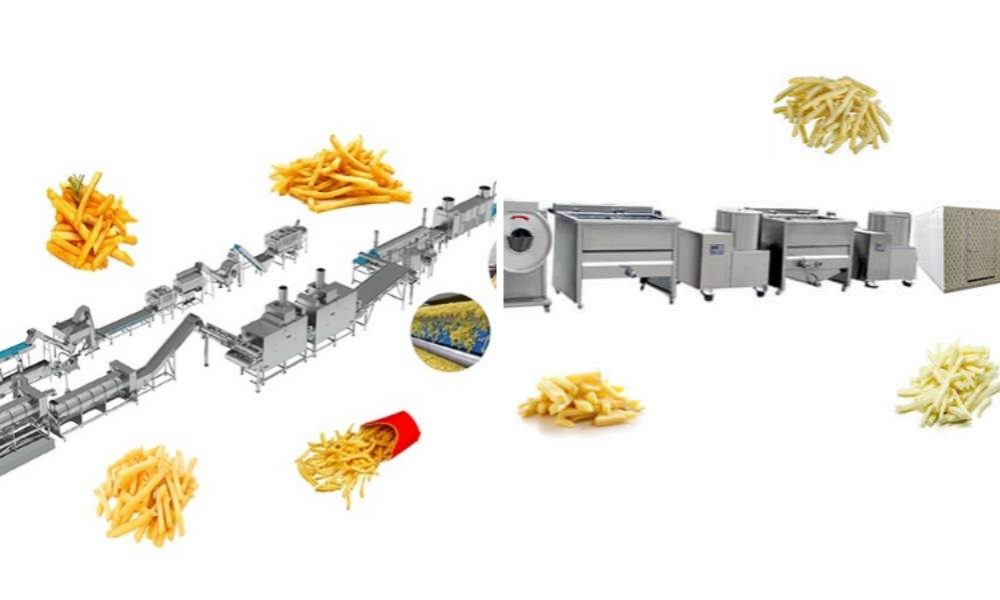
Why Manufacturers Choose Us for Their Frozen French Fries Production Line
Selecting a Frozen French Fries Production Line is a 10-15 year capital decision. The following five capabilities are proven across geographies and project sizes.
1. 15+ Years Field Commissioning
Over 40 production lines delivered in 22 countries including Nigeria, Ghana, Egypt, Algeria, Morocco, Kenya, Saudi Arabia, UAE, Iraq, Indonesia, Vietnam, Philippines, Malaysia, Bangladesh, Pakistan, Russia, Ukraine, Kazakhstan, Mexico, Colombia, India, and Brazil. All lines are commissioned by our own engineers, on-site for 4-6 weeks each.
2. Process Engineering Beyond Equipment Supply
Every project includes a raw material spec packet (variety, dry matter, reducing sugar, storage), SAPP dosing curve, two-stage blanch validation, TPM monitoring schedule, and IQF core-temperature SOP. These process controls are essential for McDonald, Carrefour, and Lulu compliance.
3. Multi-Fuel Flexibility for Emerging Markets
Our external gas heat exchanger operates on natural gas, LPG, diesel, heavy oil, and methanol with no hardware changes. In West Africa, lines run diesel year-round; in MENA, LPG is common with seasonal switching.
4. Inline Filtration That Triples Oil Life
Dual-redundant coarse filter and inline fine filter are standard on every par-fryer above 500 kg/h. On a 3000 kg/h line, this saves USD 180,000-240,000 in annual oil expense.
5. Upgrade-Path Layout Design
Every layout includes reserved footprint and utility tap-offs for future modules, enabling upgrades without scrapping the original line. This future-proofs your Frozen French Fries Production Line investment.
Plant Layout and Utility Requirements for a Frozen French Fries Production Line
A costly error is finalizing equipment before plant layout, utility loads, and civil tolerances are set. Workshops can end up 15% undersized, impacting future expansion and audit compliance.
Workshop Layout Principles
- One-way material flow: Raw potatoes enter dirty zone, then wet zone (cut/blanch/dry), hot zone (par-fry), and clean zone (cool/IQF/pack). Eliminates backtracking.
- Clean/dirty zoning: Staff uniforms, entry doors, and break rooms are separated, ensuring BRC and IFS audits pass first time.
- Overhead utilities: Steam, air, water, and power run above equipment; floor drains slope 1.5-2% toward collection points.
Utility Load Reference for 1000 kg per h Frozen Line
| Utility | Demand | Notes |
|---|---|---|
| Installed electrical | 180-220 kW | 380V/50Hz, 3-phase + N |
| Natural gas | 95-120 m3/h | Gas-fired par-fryer + steam boiler |
| Process water | 14-18 m3/h | Soft, <=200 ppm hardness |
| Saturated steam | 1.5-2.0 t/h | 0.7-0.8 MPa from 2 t boiler |
| Compressed air | 1.5-2.0 m3/min | 0.6 MPa, dry, oil-free |
| Refrigeration load | 180-220 kW | For IQF tunnel, ammonia or freon |
| Wastewater | 12-15 m3/h | BOD 1800-2400 mg/L, requires pre-treatment |
For a 3000 kg/h industrial line, scale to 350 kW electrical, 280 m3/h gas, 40 m3/h water, 4 t/h steam, and 2000-2500 m2 footprint.
Quality, Food Safety, and Certifications
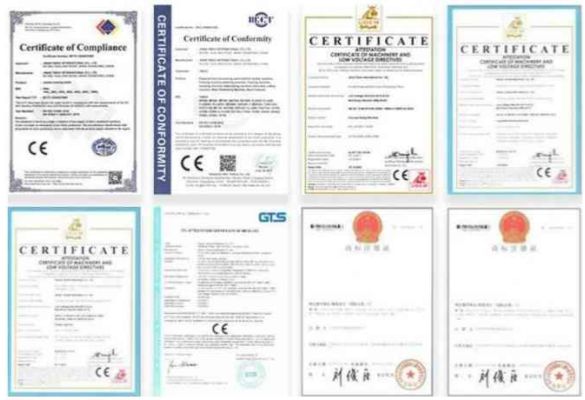
Frozen French fries are a globally traded commodity, requiring documented food-safety compliance. EU retail, US foodservice, GCC supermarkets, and African export buyers all mandate rigorous certification for procurement.
Certification Stack
- HACCP: Mandatory worldwide
- ISO 22000: Quality management system framework
- BRCGS Food Safety Issue 9: UK and most EU private-label retailers
- IFS Food: German, French, Italian retailers
- FDA 21 CFR 117: US market compliance
- GCC Halal Compliance: Middle East markets
- EAC TR CU 021/2011: Russia, Belarus, Kazakhstan, EAEU
The line carries CE marking and PED 2014/68/EU compliance for pressurized components.
Six Critical Quality Control Points (KQCPs)
KQCP-1 Raw potato sugar control: Reducing sugar <0.4% (target 0.3%). Recommend in-line refractometry plus 14-21 day storage at 7-9 deg C.
KQCP-2 Two-stage blanch validation: Polyphenol oxidase should test negative on peroxidase assay after 90 deg C stage; otherwise, color failures appear after 60-90 days frozen storage.
KQCP-3 SAPP dosing accuracy: 0.3-0.5% w/w in second blanch tank, monitored by daily titration.
KQCP-4 Acrylamide control: EU Regulation 2017/2158. Hold par-frying <=180 deg C, validate <=500 microgram/kg.
KQCP-5 Frying oil TPM: Test daily; replace before TPM exceeds 24%. Inline filtration holds TPM at 12-16% for 12-15 days.
KQCP-6 IQF core temperature: Target <=-18 deg C at tunnel exit, validated daily with thermocouple probe.
For an Industrial Frozen French Fries Production Line, a full BRCGS Issue 9 documentation pack is supplied, including 3-year acrylamide trend data and lot-level traceability. Audit readiness includes CCP validation, allergen management, and integrated utility monitoring as required by export buyers.
Real-World Project Cases We Have Delivered
The following anonymized cases represent typical technical and commercial scenarios from our delivery portfolio. Details are preserved to inform buyers evaluating a Frozen French Fries Production Line investment.
West Africa 2000 kg per h Frozen Line, Lagos Commissioned 2022
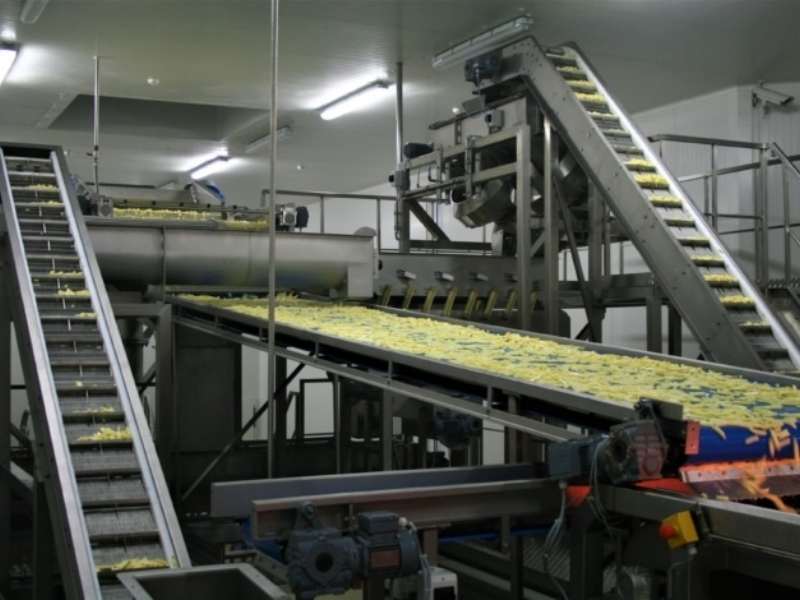
- Customer: Leading foodservice supplier to national QSR chains and hotels, seeking import substitution for frozen fries.
- Challenge: Local potato varieties with variable dry matter, unreliable gas supply, and need for export-compliant documentation.
- Solution:
- Multi-fuel external heat exchanger for diesel/LPG switching
- On-site SAPP dosing and two-stage blanch validation for color control
- Full BRCGS Issue 9 and HACCP documentation stack
- Outcome:
- 97% OEE after 6 months, 16% oil savings per year
- Passed EU Regulation 2017/2158 acrylamide audit at first attempt
- Key Lesson: Multi-fuel design and documentation readiness are critical for West African export plants.
Southeast Asia 1000 kg per h Frozen Line, Surabaya Commissioned 2021
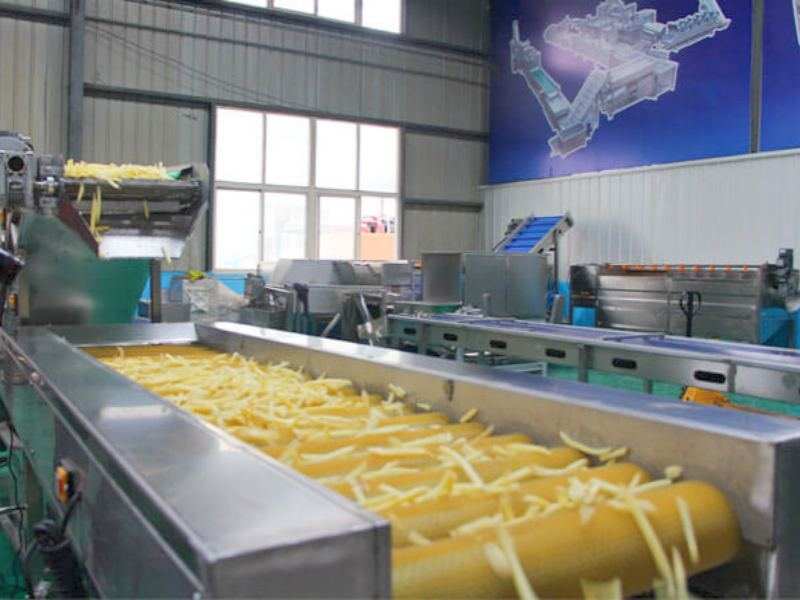
- Customer: Regional snack and frozen food brand expanding into quick-service restaurant supply.
- Challenge: High humidity, palm oil cost volatility, and need for flexible output (fresh and frozen fries).
- Solution:
- Fluidized-bed IQF tunnel with variable fin spacing for tropical humidity
- Dual-format cutting module for rapid changeover
- Inline oil filtration and TPM monitoring to extend oil life
- Outcome:
- Annual oil cost reduced by USD 190,000
- Changeover time between fresh and frozen reduced to 40 minutes
- Key Lesson: Flexibility in cutting and freezing is essential for Southeast Asian mixed-format plants.
South Asia 3000 kg per h Frozen Line, Pune Commissioned 2023
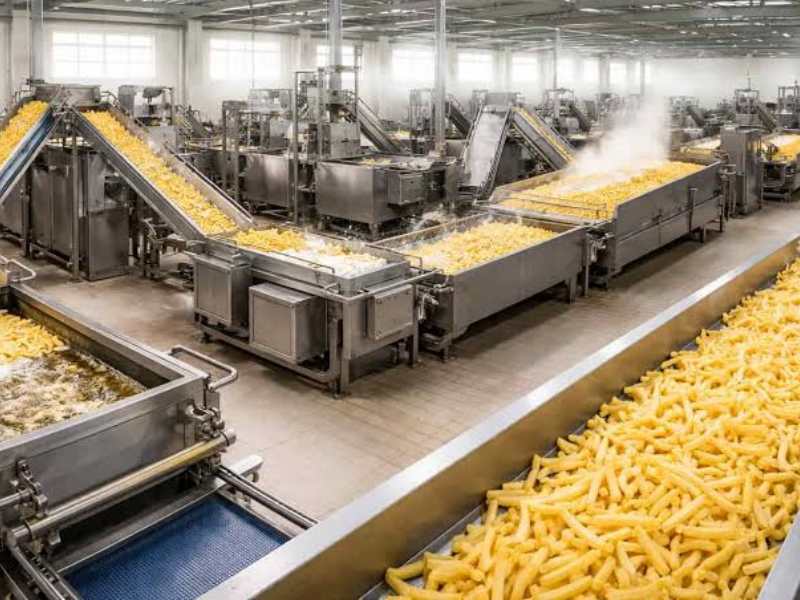
- Customer: Export-oriented processor supplying GCC and EU supermarket chains.
- Challenge: Lot-level traceability, high labor cost, and full IFS Food and BRCGS certification for EU audit.
- Solution:
- Centralized SCADA control with 3-operator crew for labor compression
- Lot tracking with barcode and batch print integration
- Pre-allocated upgrade bay for future snack fries module
- Outcome:
- Passed EU supermarket audit on first attempt
- Labor costs reduced by 28% versus legacy line
- Key Lesson: Full automation and audit-ready traceability are non-negotiable for export-driven South Asian plants.
CapEx, OpEx, and ROI Math for a Frozen French Fries Production Line
The following investment model is based on a 500 kg/h automatik sepenuhnya Frozen French Fries Production Line with real project cost data.
CapEx Breakdown
| item | % of Total | Notes |
|---|---|---|
| Process equipment | 60% | EXW basis |
| Civil works and foundations | 12-15% | Greenfield vs brownfield |
| Utility build-out | 8-10% | Boiler, transformer, refrigeration |
| Installation and commissioning | 7-9% | Our engineers on-site 4-6 weeks |
| Spare parts (Year 1) | 4-5% | Belts, bearings, filters |
| Operator training | 1-2% | 2-3 weeks, language-specific |
| Contingency | 5-8% | Recommended buffer |
Total project CapEx for the 500 kg/h tier is USD 580,000-850,000, with equipment scope at USD 380k-520k EXW.
OpEx Structure
| OpEx Category | % of Revenue | Notes |
|---|---|---|
| Raw potato | 38-42% | ~USD 0.30/kg, 50% yield |
| Frying oil | 8-11% | Palm oil, with our filtration 12-15 day life |
| Energy (gas + electric) | 6-9% | Lower if grid is cheap |
| Direct labor | 4-7% | Geography-dependent |
| Packaging materials | 5-7% | Bags, cartons |
| Maintenance and spares | 2-3% | After Year 1 |
| Other (water, treatment, QC) | 2-3% | – |
ROI Illustration
500 kg/h x 14 hr/day x 300 days = 2100 tonnes finished fries/year. At wholesale USD 1.10-1.30/kg, annual revenue is USD 2.3-2.7 million. EBITDA margin of 22-28% yields payback in 24-32 months (total project), or 18-24 months (equipment only), assuming stable raw potato supply.
For African markets, diesel fuel adds 2-3 points to energy OpEx. In Southeast Asia, palm oil cost advantage and lower labor compress OpEx by 3-4 points. Middle East plants benefit from subsidized gas, dropping energy below 5%. Industrial fully-automatic lines reduce labor to 3-4% but raise maintenance to 3-4%. For Fresh lines, oil drops to 5-7% but cold-chain logistics adds 3-4%. For Coated lines, seasoning adds 4-6 points, but premium pricing offsets this.
Frequently Asked Questions About Frozen French Fries Production Line
How is a French fries line different from a potato chips line?
There is a 70% overlap in peeling, washing, and packaging, but cutting (strip vs slice), blanching (two-stage vs single), par-frying (50-140 sec vs 3-3.5 min), and freezing (IQF vs immediate seasoning) are entirely different. Combined lines add 15-20% to CapEx.
What is the typical investment range?
Total project cost ranges from USD 280k for a 200 kg/h plant to USD 5M+ for a 3000 kg/h industrial export facility. Equipment typically accounts for 60-65% of CapEx.
What is the smallest viable capacity?
100 kg/h finished output is the practical floor for a frozen plant. Below this, fixed costs (refrigeration, packaging, QC lab) are not favorable. Fresh-cut lines can be viable at 50 kg/h.
Can the line produce both fresh and frozen fries?
Yes, fresh fries skip the IQF tunnel and are packed into chilled cartons after par-frying. The same line can switch with a 30-45 minute changeover.
What potato varieties work best?
Russet Burbank (US/Canada), Innovator (EU), Shepody (early-season), and Lady Claire or Markies are preferred. Target 20%+ dry matter and reducing sugar below 0.4%.
What is the project lead time?
Manufacturing is 10-14 weeks, sea shipment 4-6 weeks, installation and commissioning 8-10 weeks. The total contract-to-startup window is 24-28 weeks.
What certifications are required for export?
For EU: HACCP plus BRCGS or IFS and EU 2017/2158 acrylamide compliance. For US: FDA 21 CFR 117, FSVP, and a GFSI-recognized scheme. Halal and kosher are market-specific.
What is the typical ROI window?
At 14 hr/day x 300 days, producing about 2100 tonnes/year at USD 1.10-1.30/kg wholesale, EBITDA margin is 22-28%, equipment payback 18-24 months, and total project payback 24-32 months.
 Malay
Malay  English
  Spanish
  French
  Arabic
  Russian
  Portuguese
  German
  Italian
  Indonesian
  Uzbek
Uzbek