

200kg/h Semi-Automatic Potato Chips Plant Case Study — Surat, India
How a First-Time Food Entrepreneur Built a Multi-Product Snack Brand with a Semi-Automatic Line Under $48,000
| Parámetro | Detail |
|---|---|
| Project Location | Surat Industrial Estate (Udhna), Gujarat, India |
| Client Type | First-time food entrepreneur; previously wholesale spice trader |
| Production Capacity | 200 kg/h (finished chips, potato-based) |
| Operation Mode | Semi-automatic, 8 operators + 1 supervisor |
| Installed Equipment | Washing & peeling, slicing, blanching, batch dewatering, batch frying, batch deoiling, octagonal drum seasoning, nitrogen-flush packaging |
| Floor Area | 280 m² (production + raw material storage + finished goods) |
| Total Investment | ~$46,800 (equipment, installation, site preparation, initial raw materials) |
| Commissioning Date | August 2024 |
| Primary Products | Plain salted potato chips, masala potato chips, banana chips (sweet), sweet potato chips |
| Target Market | Surat City + 3 neighboring districts (Valsad, Navsari, Bharuch); local kirana stores, snack distributors, 2 regional supermarket chains |

Client Background & Requirements
Mr. Patel had spent twelve years in the wholesale spice trade in Surat’s Mahidhapura market. He knew distribution channels, he knew kirana store owners by name, and he understood Gujarat’s snack consumption patterns intimately. What he lacked was manufacturing experience.
His rationale for entering snack manufacturing was pragmatic: Gujarat’s packaged snack market was dominated by brands headquartered in other states — primarily from Maharashtra and Rajasthan — and the freight cost alone added 8–12% to wholesale prices in Surat. A locally manufactured product, delivered within 24 hours, could undercut those brands on both price and freshness.
He approached us with five non-negotiable requirements:
Capital ceiling. He had allocated ₹40 lakh (~$48,000 at the time) for the entire project — equipment, civil work, electrical upgrades, and initial raw material stock. There was no room for scope creep.
Multi-product capability from day one. The line had to switch between potato chips, sweet potato chips, and banana chips without major reconfiguration. He believed — correctly — that a single-product brand would struggle to secure shelf space against established competitors with full product ranges.
Labor-based operation. Skilled automation engineers were scarce in Surat’s industrial belt, but semi-skilled labor was abundant and affordable. He explicitly preferred manual control points where operators could visually inspect product quality at multiple stages.
Compact footprint. The available shed in Udhna GIDC measured 12m × 24m (288 m²). Every machine had to fit this rectangle, with clear walkways and a logical material flow.
Rapid commissioning. The Diwali snack season (October–November) represented 35–40% of Gujarat’s annual packaged snack sales. Missing that window meant losing the most critical launch opportunity of the year.
These constraints ruled out a fully automatic line — both on cost and on the client’s operational philosophy. The semi-automatic configuration was not a compromise; it was the strategically correct choice.
Engineering Decision Rationale
Several engineering choices shaped this project in ways that differ fundamentally from large-scale automatic installations. I will walk through the most consequential decisions.


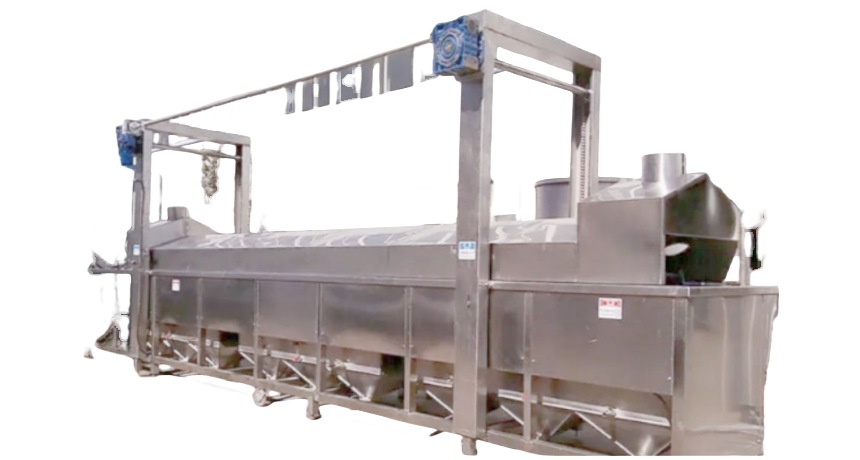


1. Batch Frying Over Continuous Frying
A continuous fryer rated at 200 kg/h costs roughly 2.3–2.7× more than an equivalent-capacity batch fryer system. But the cost argument alone missed the operational advantage. Mr. Patel needed to fry three different products — each with different oil temperatures, residence times, and moisture targets:
| Product | Oil Temperature | Frying Time | Target Moisture |
|---|---|---|---|
| Potato chips (standard thickness) | 175–180°C | 3–3.5 min | ≤2.0% |
| Sweet potato chips | 165–170°C | 2.5–3 min | ≤2.5% |
| Banana chips (ripe) | 155–160°C | 4–5 min | ≤3.0% |
With a continuous fryer, switching between these profiles would require draining the oil, cleaning the conveyor, resetting parameters, and wasting 15–20 kg of product during stabilization. With two batch fryers running in parallel, he could dedicate Fryer A to potato chips and Fryer B to banana or sweet potato chips simultaneously — or run all three products in sequence with a 10-minute washout between batches.
We specified two 100 kg/batch gas-heated rectangular fryers with automatic basket lifting and independent temperature controllers. The gas heating choice was deliberate: Surat’s industrial electricity tariff was ₹8.40/kWh at the time, while piped natural gas cost the equivalent of ₹4.20/kWh thermal. Over a 14-hour production day, gas heating saved approximately ₹1,800–2,200 daily compared to electric.
2. Octagonal Seasoning Drum Instead of Rotary Cylindrical
A rotary cylindrical drum seasoner would be the default choice for a 200 kg/h line. We recommended the octagonal type instead, for a reason specific to Mr. Patel’s product range.
Octagonal drums create a tumbling action where product falls and turns at each angle change (every 45° of rotation). For masala-coated chips — his flagship product in the Gujarat market — this tumbling action distributed the spice blend more uniformly than a smooth cylindrical drum, where product tends to slide rather than tumble. The difference in seasoning adhesion uniformity, measured across 50-sample tests during commissioning, was 8–12% better with the octagonal drum.
The trade-off: octagonal drums process roughly 15% less volume per batch than a same-size cylindrical drum. At 200 kg/h, this was acceptable. At 500 kg/h, the throughput penalty would have been disqualifying.
3. Manual Sorting Station Between Washing and Slicing
In a fully automatic line, potatoes move directly from the peeler to the slicer via conveyor. We inserted a manual sorting table — a 2m stainless steel table with two operators — between these stages.
The rationale: Mr. Patel’s raw potato supply came from three different mandi (wholesale market) sources in Surat and Navsari, with inconsistent grading. A 200 kg/h line processes roughly 330–350 kg of raw potatoes per hour. Even a 3% defect rate (rots, green spots, oversized tubers that jam the slicer) means 10 kg of problem material entering the slicer every hour. Two operators visually inspecting and trimming potatoes eliminated 95%+ of defects before slicing. The labor cost: ₹350/day per operator. The avoided cost: slicer blade damage, product contamination, and downstream waste — estimated at ₹1,200–1,800/day.
This was not a cost-saving decision. It was a quality assurance decision that happened to be economically justified.
Equipment Configuration & Technical Specifications
| Station | Model/Type | Key Spec | Fuerza | Operators |
|---|---|---|---|---|
| Lavado y pelado | Brush-type, semi-auto, 300 kg/batch | Abrasive rollers, water spray | 3.0 kW | 1 |
| Manual Sorting Table | SS304, 2000×800mm | LED inspection lighting | — | 2 |
| Máquina rebanadora | Rotary blade, semi-auto, 200 kg/h | 1.0–3.0mm adjustable thickness | 1.5 kW | 1 |
| Maquina blanqueadora | Batch-type, 200L, gas-heated | 85–95°C, 2–3 min | 0.5 kW + gas | 1 |
| Batch Dewatering | Centrifugal, 30 kg/batch | 0–5 min timer, SS304 basket | 2.2 kW | 1 |
| Batch Fryer ×2 | Rectangular, 100 kg/batch, gas-heated | Independent PID controllers, auto-lift | 0.75 kW×2 + gas | 2 |
| Batch Deoiling | Centrifugal, 25 kg/batch | 900 RPM, SS304 | 1.5 kW | 1 |
| Octagonal Flavoring | 50 kg/batch, SS304 | Variable speed 10–25 RPM | 1.1 kW | 1 |
| Weighing & Packaging | Multi-head weigher + nitrogen flush sealer | 10–200g packs, <1% O₂ residual | 3.0 kW | 2 |
| Total | — | — | ~13.8 kW + gas | 12* |
*Includes 1 supervisor and 3 workers shared across packing, material handling, and sanitation. Not all stations run simultaneously.
This configuration delivered 200 kg/h finished product with standard potato chips. During mixed-product runs (e.g., 150 kg/h potato + 50 kg/h banana), throughput dropped to approximately 170–185 kg/h due to fryer changeover time. Mr. Patel found this acceptable, scheduling mixed runs on lower-demand weekdays and single-product potato runs on weekends.
Process Flow & Plant Layout
The Udhna shed measured 12m × 24m. We divided the rectangle into five functional zones with a linear flow that minimized backtracking:
The critical design decision was placing the thermal zone (Zone C) adjacent to an external wall with two industrial exhaust fans (4,500 CFM each) venting directly outside. In Surat’s summer, where ambient temperatures reach 42°C and humidity exceeds 70%, inadequate ventilation would make the production area unworkable. We specified a negative-pressure ventilation system: exhaust fans on the thermal zone wall, intake louvers on the opposite wall in Zone A, creating a cross-draft that pulled cooler air across the entire production floor.
Additionally, a 200mm raised concrete plinth separated the wet zone (Zone B) from adjacent zones, with trench drains sloping toward a central grease trap before connecting to the Udhna GIDC effluent line. The local industrial authority required a three-chamber grease trap for any food processing facility — we installed a pre-fabricated 1,500L unit with a removable baffle system for monthly cleaning.
Installation & Commissioning
The installation timeline was compressed to 18 days — aggressive for a greenfield project — because the Diwali production ramp needed to start by September 1.
Timeline
| Phase | Duration | Key Activities |
|---|---|---|
| Civil preparation | Days 1–5 | Floor epoxy coating, drainage, electrical panel upgrade to 45 kVA, gas line connection, ventilation installation |
| Equipment positioning | Days 6–8 | Machine placement, leveling, utility hookups |
| Dry commissioning | Days 9–11 | Power-on tests, safety interlock checks, dry runs |
| Wet commissioning | Days 12–15 | Water tests, oil heating tests, first product trials |
| Operator training | Days 16–18 | Hands-on operation, cleaning SOPs, quality check training |
The Slicer Problem
On Day 13, during the first potato chip trial run, we encountered an issue that illustrated why semi-automatic lines demand a different troubleshooting approach than fully automatic ones.
The slicer produced acceptable chip thickness (1.50–1.55mm target, measured at 1.48–1.62mm across 30 samples) but generated an unexpected number of broken chips — roughly 12–14% breakage rate, compared to a target of ≤5%. The operators, who had received two days of training, initially assumed the potato variety (a locally sourced Kufri Jyoti cultivar with higher starch content) was the cause.
Investigation revealed a simpler explanation: the operators were loading potatoes into the slicer hopper in batches of 8–10 kg at a time, creating uneven feed pressure. The slicer’s rotary blade performed best with a continuous, steady feed of 3–5 potatoes at a time. The fix was an operator retraining session — 45 minutes of hands-on practice with feed rate control — not a machine adjustment. Breakage dropped to 6.2% within the same day and stabilized at 4.8% by Day 17.
This episode reinforced why Mr. Patel’s preference for manual control points was sound: the problem was visible to any attentive operator but invisible to an automated feed system, which would have continued producing 12% breakage until someone noticed the waste downstream.
Oil Management Training
Semi-automatic fryers require operators to manage oil quality manually — there is no automated oil filtration or turnover system. We trained the team on a simple protocol:
- Skim floating particles every 30 minutes during frying (using a fine-mesh hand skimmer)
- Filter oil through a 200-mesh screen at the end of each production day while oil is still warm (40–50°C)
- Measure free fatty acid (FFA) levels every 3 days using a simple titration kit (target: ≤0.5% as oleic acid)
- Full oil change when FFA exceeds 0.8% or after 24 hours of cumulative frying time, whichever comes first
- Rotate oil between fryers: drain Fryer A’s oil, filter it, use it in Fryer B; put fresh oil in Fryer A
This last practice — oil rotation — extended total oil life by approximately 30% compared to independent oil management per fryer, saving an estimated ₹8,000–10,000 monthly in oil costs.
Operational Challenges & Adjustments
Beyond the slicer and oil management issues addressed during commissioning, three operational challenges emerged during the first six months of production.
Challenge 1: Raw Potato Supply Variability
Mr. Patel sourced potatoes from three Surat mandi suppliers. The Kufri Jyoti variety he preferred (for its low reducing sugar content, which minimizes acrylamide formation during frying) was not always available. During October–November 2024, two of his three suppliers delivered Kufri Badshah — a variety with 15–20% higher reducing sugar content, resulting in visibly darker chips at the same frying temperature.
Adjustment: We recalibrated the frying parameters for Kufri Badshah: reducing oil temperature from 178°C to 170°C and extending frying time from 3.2 to 3.8 minutes. This produced acceptable color (Agtron value 58–62, within the 55–65 target range) at a cost of approximately 7% lower throughput during Badshah runs. The alternative — rejecting Badshah shipments — would have halted production entirely during supply gaps.
We also recommended that Mr. Patel install a simple reducing sugar test kit (3,5-dinitrosalicylic acid colorimetric method, ~₹1,500 per kit, 50 tests) to screen incoming potato batches at receiving. He implemented this in January 2025, and it has since prevented two additional Badshah batches from entering production without parameter adjustments.
Challenge 2: Banana Chip Browning During Storage
Mr. Patel’s banana chips — a premium product sold at 2.3× the price of potato chips — developed brown spots within 7–10 days of packaging during the monsoon season (June–September). Investigation traced the issue to residual moisture: the target moisture of ≤3.0% was adequate for potato chips in nitrogen-flushed packaging, but banana chips contain higher levels of reducing sugars that undergo Maillard browning even at low water activity.
Adjustment: Three changes were implemented:
- Lower frying temperature, longer time: 152°C for 5.5 minutes (previously 158°C for 4.5 minutes), achieving ≤2.0% moisture
- Extended deoiling: 90 seconds at 900 RPM (previously 60 seconds), removing more surface oil that could oxidize
- Desiccant sachets: Silica gel packets (2g per 100g pack) added to banana chip packaging during monsoon months only
Shelf life for banana chips extended from 7–10 days to 35–40 days, reducing distributor returns from 6.2% to 1.1% of banana chip shipments.
Challenge 3: Workforce Skill Retention
Of the 12 workers trained during commissioning, 4 left within the first three months — a turnover rate consistent with Surat’s industrial labor market, where textile and diamond polishing units compete aggressively for semi-skilled workers.
Adjustment: Mr. Patel redesigned the training approach. Instead of training each worker on a single station, he implemented a rotation system where every worker learned at least three stations over their first 60 days. This achieved two things: (1) any single departure did not cripple a specific station, and (2) workers reported higher job satisfaction from varied work. He also introduced a modest production bonus (₹150/day when daily output exceeded 1,500 kg finished product), which reduced monthly turnover from 33% to approximately 15% by Month 4.
Measured Performance & Output Indicators
After 9 months of operation (September 2024 – May 2025), the plant’s performance stabilized within predictable ranges. Here are the key metrics:
| KPI | Target at Commissioning | Achieved (6-Month Average) | Notes |
|---|---|---|---|
| Daily output (single product) | 1,600 kg (8 hrs × 200 kg/h) | 1,520 kg | 5% downtime for oil skimming, batch changeover |
| Daily output (mixed products) | 1,360 kg (8 hrs × 170 kg/h) | 1,310 kg | Includes 3 product changeovers |
| Raw-to-finished yield (potato) | 58–60% | 57.4% | Peeling loss 12%, slicing waste 3%, frying moisture loss 26%, trim 1.6% |
| Oil consumption per kg chips | 0.22 L/kg | 0.24 L/kg | Higher in first 2 months; improved with oil rotation practice |
| Chip breakage rate | ≤5% | 4.6% | Stabilized after slicer retraining |
| Labor productivity | 25.0 kg/worker/hour | 23.8 kg/worker/hour | Includes supervisor; excludes packers |
| Energy cost per kg | ₹3.50 target | ₹3.82 | Gas price increase in Q1 2025 contributed ₹0.18 |
| Monthly production volume | ~38,000 kg | ~36,800 kg | 24 working days/month |
| Distributor return rate | <3% | 2.4% | Primarily banana chips before Q1 2025 fix |
| FFA at oil discard | ≤0.8% | 0.72% (avg) | Oil rotation extended usable life |
Financial Performance
| Metric | Value |
|---|---|
| Average selling price (wholesale, plain salted) | ₹160/kg |
| Average selling price (wholesale, masala) | ₹185/kg |
| Average selling price (wholesale, banana chips) | ₹220/kg |
| Blended average selling price | ₹178/kg |
| Raw material + labor + energy + packaging cost per kg | ₹112/kg |
| Gross margin per kg | ₹66/kg (37.1%) |
| Monthly gross profit | ~₹24.3 lakh |
| Equipment + setup amortization (36-month linear) | ~₹1.1 lakh/month |
| Estimated payback period | ~14.5 months |
Mr. Patel achieved operational breakeven (monthly revenue > monthly variable costs) in Month 2. The full investment payback on equipment and setup costs is projected for November 2025 — approximately 14.5 months from commissioning.
Client Feedback & Business Impact
In a quarterly review call in March 2025, Mr. Patel shared several observations that are worth recording for clients considering a similar setup:
On the multi-product strategy:
“The banana chips saved my business in the first two months. Potato chip sales built slowly — kirana store owners already had two or three potato chip brands on their shelves and weren’t eager to add a fourth. But nobody in Surat was doing packaged banana chips with consistent quality. That product got my foot in the door. Once the distributors trusted my banana chips, they gave shelf space to the masala potato chips too.”
This validates the multi-product approach for new entrants. A single-product launch would have faced far steeper market resistance.
On semi-automatic operation:
“I was worried that manual operation would mean inconsistent quality. The opposite happened. My frying operator, Ramesh, can now tell by the sound of the oil whether the temperature is right — he adjusts the gas valve before the PID controller even registers the drift. You don’t get that with a fully automatic machine.”
This kind of tacit operator knowledge is a genuine operational asset in semi-automatic environments — and a factor that is difficult to quantify in specification sheets but meaningfully impacts daily output quality.
On the training investment:
“The first three months were hard. I spent more time training people than selling chips. But now I have six workers who can run any station on the line. When someone calls in sick, production doesn’t stop.”
Business expansion indicators (as of May 2025):
- Distributor network: expanded from 3 to 11 distributors covering all of South Gujarat
- Retail touchpoints: ~480 kirana stores + 2 regional supermarket chains (22 outlets combined)
- Brand recognition: Mr. Patel’s masala chips now command a 5% price premium over the nearest local competitor, attributed to consistent seasoning quality
- New product: Trial production of masala makhana (fox nut) began in April 2025 using the same octagonal seasoning drum — zero additional equipment cost
- Second shift under evaluation: Demand is approaching single-shift capacity. A second 8-hour shift would require only 6 additional workers (stations with lower utilization can remain single-shift with buffer stock between stages)
Ready to evaluate a semi-automatic setup for your market? Request a Case Study for Your Capacity — we will model the equipment configuration, estimated investment, and projected payback specific to your production volume, product range, and local cost structure.
Delivery Photos Of 200kg/h Semi-Automatic Potato Chips Plant — Surat, India


 Spanish
  English
  French
  Arabic
  Russian
  Portuguese
  German
  Italian
  Indonesian
  Malay
Malay  Uzbek
Uzbek