

A Mid-Scale Brand’s Capacity Upgrade in West Java
Project Snapshot
Before getting into the story, here is the one-card overview Pak Hendra (the client) and our project manager signed off on after commissioning was completed in November 2024.
| Artículo | Detail |
|---|---|
| Client | A mid-scale local snack brand based in Bandung, West Java (kabupaten Bandung Barat) |
| Product | Fresh-sliced keripik kentang in 35g and 75g retail bags |
| Capacidad | 300 kg/h finished chips, single shift = 8 hours, 22 working days/month |
| Raw material | Granola and Atlantic potatoes sourced from Pangalengan highland farms |
| Project mode | Equipment supply + installation + 10-day on-site training (not full turnkey) |
| Fuente de alimentación | 380V / 3-phase / 50Hz |
| Workshop area | 240 m², single-floor, L-shaped layout |
| Total investment | USD 78,000–82,000 (equipment + sea freight + installation) |
| ROI period | ~14 months, based on the client’s reported figures |
| Commissioning | November 2024 |

Client Background & Why They Came to Us
Pak Hendra’s family had been running a small snack workshop in Bandung since 2017. They started with three manual woks and two staff, frying keripik kentang by hand and supplying neighborhood warung and a couple of pasar tradisional vendors. By early 2024 things had changed — a regional minimarket chain (similar in size to a small Alfamart franchise group) offered them a private-label contract for 18 tons per month. Their existing setup could do maybe 4 tons. The math did not work.
Hendra found us through a fairly specific Google search — he told us later he typed something like “potato chips production line manufacturer 300kg Indonesia” and clicked through three suppliers before sending an inquiry. What tipped his decision was not the price (we were not the cheapest), but a 12-minute factory walkthrough video our sales engineer Dewi sent him over WhatsApp, where she actually ran a slicer on real Granola potatoes and showed the slice thickness measurement live.
His three biggest worries before signing the contract were, in his own words:
“First, I worry the chips will turn brown — Indonesian potatoes have a lot of sugar. Second, I worry about oil cost, palm oil price keeps going up. Third, I do not want to hire more than 6 people per shift, finding workers in Bandung is harder now.”
These three worries became the backbone of the entire project — and honestly, the first one almost embarrassed us during trial runs.
Raw Material & End-Product Positioning
Pangalengan, about 45 km south of Bandung city, sits at roughly 1,400 m elevation and is one of the few areas in Indonesia where Atlantic and Granola potato varieties grow with reasonable consistency. Hendra’s supply contract locked in 8 tons/week from two farmer cooperatives. The challenge with Indonesian highland potatoes is well-known among local processors: reducing sugar content can swing between 0.15% and 0.42% depending on storage temperature and harvest age, which directly affects Maillard browning during frying.
The end products were positioned for two channels:
El modern channel (the minimarket private-label contract) needed 35g pillow bags with nitrogen flushing, shelf life 6 months, target retail price IDR 5,500. The traditional channel kept Hendra’s original brand alive in 75g bags sold through pasar and small warung, with three flavors: original asin, bumbu balado, and jagung manis (sweet corn). The slicing target was a 1.4 mm flat slice — slightly thinner than the previous hand-cut 1.8 mm, to match the modern-channel competitor on bite-feel.
We did not design this line for wave-cut or compound chips. Keeping the scope tight was deliberate; mid-scale clients who try to do everything in one line usually regret it within 18 months.
Process Flow & Equipment Configuration
The full process from raw potato intake to sealed bag goes through 11 stations. Below is the simplified flow.
Equipment list (the actual sheet from the shipping invoice, slightly simplified):
| # | Equipment | Modelo | Key spec | Fuerza |
|---|---|---|---|---|
| 1 | Bubble washer | BW-500 | SUS304, 500 kg/h throughput | 2.2 kW |
| 2 | Carborundum peeler | CP-300 | Batch 30 kg, peel loss 4.5–6% | 3 kW |
| 3 | Slicer | SL-300 | 5-blade head, 280 rpm | 2.2 kW |
| 4 | Slice washer | SW-300 | Two-stage spray + soak | 1.5 kW |
| 5 | Maquina blanqueadora | BL-300 | Belt length 4.5 m, temp 75–85°C | 36 kW (electric) |
| 6 | Air-knife dewatering | AK-300 | 3 air knives, 5.5 kW blower | 5.5 kW |
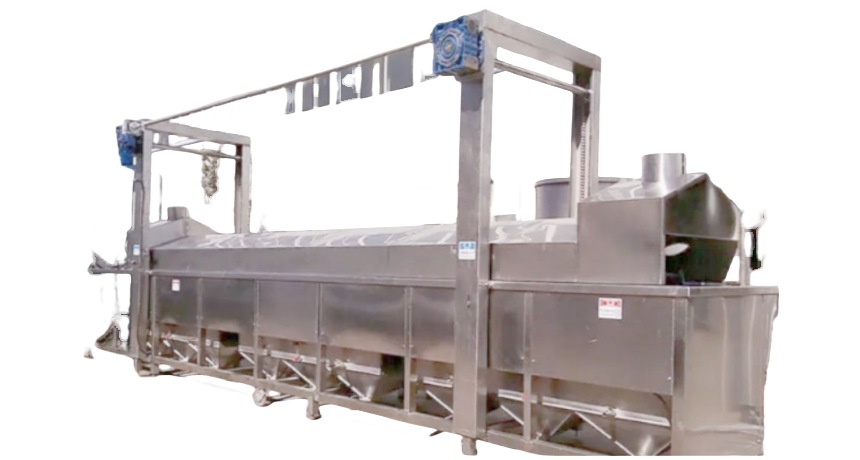
| 7 | Continuous fryer | CF-300G | Gas-fired, oil volume 850L, 1.5 m × 6 m | 4 kW (motor) + LPG |
| 8 | De-oiling centrifuge | DO-300 | 380 rpm, residual oil ≤22% | 3 kW |
| 9 | Double-drum seasoning | DS-300 | Drum dia 600 mm, oil-spray + powder | 2.2 kW |
| 10 | Multi-head weigher | MW-10H | 10 heads, ±0.3g accuracy | 1.5 kW |
| 11 | VFFS bagger | VFFS-320 | Pillow bag, 35–80 packs/min, N2 flush | 3.5 kW |
Total connected load is around 64 kW, but the running load during normal production sits at roughly 38–42 kW because the blanching electric heating and the fryer are not at peak simultaneously. This was an important number for Hendra — his existing PLN connection was 53 kVA and we wanted to avoid forcing him to upgrade the transformer.
A small detail worth mentioning: the fryer is gas-fired (LPG), not electric. In Bandung, LPG is significantly cheaper per kWh-equivalent than electricity for industrial heating, and the client already had a 12-tank LPG manifold from his previous frying operation. We reused it.

Layout & On-site Implementation
The workshop measures roughly 240 m² with 4.8 m clear ceiling height. We laid out the line in an L-shape rather than a straight line because the building had a load-bearing column inconveniently placed at the 14-meter mark. The wet section (washing → blanching) runs along the north wall, then the line turns 90° and the dry section (frying → packaging) runs along the east wall, ending near the loading door.
Shipping took 31 days from Qingdao port to Tanjung Priok, then another 4 days by truck up to Bandung. Customs cleared in 6 working days — slightly slower than usual because two of the HS codes triggered a manual inspection. Installation on-site took 11 days, plus 6 days of trial runs and operator training. Two of our engineers (Mr. Liu, mechanical, and Mr. Zhao, electrical) flew in with a Bahasa-Mandarin translator from our Surabaya agent partner.
The one thing that did not go smoothly: the workshop floor was not done with food-grade epoxy when we arrived. Hendra had a local contractor doing it in parallel, but the curing time forced us to delay anchor bolting by 3 days. Lesson learned — we now send a pre-installation checklist to clients 30 days before container loading. It includes floor finish, drainage slope, exhaust hood position, and PLN load confirmation.
Challenges & Solutions
This is where the project earned its keep. Three real problems came up, and only one of them was anticipated in the original proposal.
Challenge 1: First-batch chips came out too dark
During the second day of trial runs, the chips coming out of the fryer were noticeably darker than the reference samples Hendra had approved. Color L-value measured around 58, target was 65–70. The root cause was exactly what Hendra had warned us about: the Pangalengan potatoes that week had a reducing sugar content of 0.38%, on the high side. Our default blanching parameters (75°C × 60s) and frying temperature (170°C) were tuned to typical Chinese Atlantic potatoes with 0.18–0.22% reducing sugar.
The fix was a two-step adjustment. We extended blanching to 78°C × 75 seconds to leach out more reducing sugars, and we lowered the fryer inlet temperature to 165°C with a 12-second longer residence time to compensate. By day 4 the L-value was back at 67. Honestly, this was not a brilliant engineering moment — it was just paying attention to what the client had told us upfront. We should have tuned the recipe before leaving the factory.
Challenge 2: Oil consumption higher than promised
Initial oil consumption measured at 38 L per 100 kg finished product, while our proposal had estimated 32 L. After two days of investigation we found the de-oiling centrifuge was running at 320 rpm instead of the rated 380 rpm — a wiring mistake during installation had bridged two phases incorrectly on the VFD. After correction, residual oil dropped from 27% to 21%, and overall oil consumption settled at 33–34 L per 100 kg. Not exactly the 32 L target, but within the agreed tolerance.
Challenge 3: Slice thickness drift after 4 hours of running
By the 4th hour of continuous running, slice thickness was creeping from 1.4 mm to 1.55 mm, which the operator only caught because the chips were taking longer to fry. The slicer blade gap had drifted because of thermal expansion in the cutter head — a known issue with our older SL-300 model when running hot potatoes straight from blanching makeup water. We adjusted the line so that operators measure slice thickness with a digital caliper every 90 minutes and re-shim the blade head if drift exceeds 0.1 mm. Not elegant, but it works. The next-generation SL-300H has an auto-compensation mechanism, which we offered to upgrade Hendra to in 2026.
Production Data & Client Validation
After the first 90 days of stable production, the operations team compiled the following numbers (we asked Bu Sari, the production supervisor, to share the report).
| Metric | Target | Actual (90-day average) |
|---|---|---|
| Output capacity | 300 kg/h | 289 kg/h (96.3%) |
| Yield rate (raw potato → finished) | 28% | 27.4% |
| Oil consumption | 32 L/100kg | 33.6 L/100kg |
| Operators per shift | 6 | 5 |
| Energy (electricity) | 0.42 kWh/kg | 0.45 kWh/kg |
| LPG consumption | — | 0.18 kg/kg finished |
| Bag rejection rate | ≤1.5% | 1.2% |
| Color L-value | 65–70 | 66.8 (avg) |
The 96.3% capacity achievement is realistic — the 3.7% gap mostly comes from the 12-minute oil-filtration cleaning cycle every 4 hours, which the original spec sheet did not account for. Hendra’s comment three months in:
“The line runs OK. Not perfect — we still have small problems with the seasoning drum sometimes — but my workers can run it without me being in the workshop. That is what I needed.”
Not the most enthusiastic testimonial, but for a B2B equipment project, “the line runs and the boss doesn’t need to babysit it” is honestly a pretty good outcome.




Investment & ROI Breakdown
The project’s economics, based on Hendra’s reported figures (we cannot independently verify all of them, but they are consistent with what we see at similar Indonesian projects):
Investment side:
- Equipment FOB Qingdao: USD 62,000
- Sea freight + insurance to Tanjung Priok: USD 4,800
- Inland trucking + customs clearance: USD 3,400 (≈ IDR 53 million)
- Installation, training, engineer travel: USD 8,500
- Local civil works (epoxy floor, exhaust): IDR 95 million ≈ USD 6,000
- Total: ~USD 80,000 (~IDR 1.27 billion at exchange rate of the time)
Operating economics per 35g bag (modern channel):
| Cost component | IDR per bag |
|---|---|
| Raw potato | 1,180 |
| Palm oil | 720 |
| Seasoning | 210 |
| Packaging film + N2 | 450 |
| Labor | 280 |
| Energy (PLN + LPG) | 240 |
| Depreciation (5-year line) | 320 |
| Total cost | ~3,400 |
| Selling price to minimarket chain | ~4,800 |
| Gross margin | ~29% |
At 18 tons/month dedicated to the modern channel plus another 9 tons through traditional channels, monthly gross profit lands around IDR 90–110 million. The payback period works out to roughly 13–15 months, which is in line with what we usually see for 300kg/h fresh potato lines in Indonesia where palm oil and LPG are both relatively affordable. Actual results may vary depending on potato price volatility — and in early 2025, when Pangalengan prices spiked 22% due to flooding, Hendra’s margin temporarily dropped to about 21%.
After-sales & Ongoing Support
The standard package included a 12-month warranty on main equipment (24 months on motors and gearboxes), a wear-parts kit shipped with the line (spare slicer blades, fryer thermocouples, two extra heating tubes, fryer gaskets, and seasoning drum brushes), and remote support via a dedicated WhatsApp group with three of our engineers.
Six months after commissioning, Hendra ordered a second multi-head weigher to support a new 18g sachet SKU for school canteens. We shipped it air-freight in 11 days because his sales window was tight. In April 2025 we did a paid on-site annual inspection — Mr. Liu flew back, checked the fryer oil filtration, replaced two thermocouples, and trained two new operators. That visit cost Hendra USD 1,800 plus airfare, which he considered fair value.
Going forward, the line is registered with our service team for quarterly remote video check-ins, and we hold 35 commonly-needed spare parts in our Surabaya agent’s warehouse — average replenishment time to Bandung is now 3–5 days instead of the 4–6 weeks it used to take from China.
Related Indonesia Projects
If you are evaluating a similar investment, these other case studies on this site may be more relevant to your scenario:
- For a smaller starting investment with a single-phase power constraint: a 150kg/h small-scale potato chips line built for a Surabaya entrepreneur
- For tuber alternatives to fresh potato: a turnkey cassava chips processing project in Lampung
- For Pringles-style stacked chips made from potato flake and starch blends: a compound potato chips line case in Jakarta
- For factories aiming at full automation and minimal labor: an automated potato chips manufacturing plant for a national-scale Indonesian customer
FAQ + CTA
In Indonesia, particularly in West Java and Central Java, industrial LPG delivered in 50kg tanks works out to roughly 35–45% cheaper per useful kWh than PLN industrial electricity, especially at higher load tiers. For a continuous fryer running 8+ hours daily, that difference compounds into millions of rupiah per month. Pak Hendra also already had an LPG manifold from his previous operation, so the sunk cost was zero.
Yes, but the blanching and frying parameters need re-tuning each time the source changes significantly. We provide a parameter card with tested settings for Pangalengan Granola, Pangalengan Atlantic, Dieng Atlantic, and Australian fresh imports. Cassava and sweet potato cannot be processed on this line — they need a different peeler and slicer.
The contact surfaces are SUS304 (food contact) and SUS316 (oil-contact components in the fryer), which meets BPOM’s material requirements. The packaging film used in this project is BPOM-registered laminate from a local Surabaya supplier. The full HACCP documentation package — including CCP identification at blanching, frying, and packaging — was prepared by Hendra’s QA consultant, not by us; we only provided equipment-side documentation. SNI 2886:2015 (the Indonesian standard for makanan ringan ekstrudat, which extends to fried potato chips in practice) is achievable on this line with the parameter set described above.
The line itself can run at reduced capacity (down to about 180 kg/h) without efficiency loss, so the client can continue serving the modern-channel contract using more expensive imported potatoes during disruption windows. During the 2025 flood, Hendra ran the line at 220 kg/h for 6 weeks using a mix of Dieng-sourced potatoes and small lots from East Java. Margin shrank but production continued.
It is realistic for clients who have a confirmed off-take agreement — like Hendra’s minimarket private-label contract — covering at least 60% of capacity from month 2 onwards. Without a confirmed channel, ROI tends to stretch to 22–28 months because of slow market entry. We always tell prospective clients: secure your distribution before signing the equipment contract, not after.
Talk to an Engineer About a 300kg/h Line for Your Market
If you are considering a similar 300kg/h fresh potato chips production line in Indonesia or any other Southeast Asian market, the most useful next step is a 30-minute video call with one of our process engineers. Bring your potato sample data (variety, reducing sugar if available, average size), your target product spec, and your local power and gas situation. We will share the actual parameter card from this West Java project and tell you honestly whether your scenario is closer to Hendra’s, or whether you need a different configuration.
 Spanish
  English
  French
  Arabic
  Russian
  Portuguese
  German
  Italian
  Indonesian
  Malay
Malay  Uzbek
Uzbek