

The production facility is located approximately three kilometers from Mile 12 Market in Kosofe. The building is a converted warehouse with a corrugated steel roof and existing concrete flooring. Ambient humidity in this coastal zone consistently exceeds seventy percent, and airborne chloride content accelerates metal corrosion. The project involved the conversion of an informal charcoal-based frying operation into a NAFDAC-registered automatic production line.

Raw Material Supply & Market Position in Lagos
South-West Nigeria, encompassing Oyo, Ogun, and Lagos hinterland, serves as the primary supply corridor for plantain entering Lagos metropolitan markets. French plantain dominates wet-season harvests from July through October, while the Horn variety, denser and lower in moisture, is available from November through February. Fruit arrives at Mile 12 and other wholesale markets in twenty-to-forty-kilogram bunches without cold-chain intervention, meaning post-harvest ripening advances rapidly once the product reaches the processor.
Finished product moves through informal and formal channels. Fifty-gram polyethylene sachets retail for ₦200 to ₦300 through school kiosks, bus stops, and highway vendors. Bulk cartons move north through the Seme border into Benin and Niger Republic. Supermarket chains including Shoprite and Spar have historically sourced imported packaged plantain chips from Ghana and Asia, as informal domestic producers lack NAFDAC registration and standardized packaging. This leaves a supply gap that formal factory production is positioned to fill.
Regulatory pressure intensified this shift. NAFDAC enforcement of factory zoning and hygienic separation requirements tightened in 2023, while import duties on finished snack products increased. Local production at medium scale became economically preferable to informal manufacturing or cross-border importation.

Customer Background & Project Origin
The customer had operated informal plantain chip production at Mile 12 Market since 2019. The prior setup consisted of three charcoal-fired kettle fryers under tarpaulin cover, with manual slicing and hand-packing into polyethylene bags. Weekly output was approximately 150 kilograms, sold in bulk to school vendors and local traders.
The decision to formalize production was triggered in March 2023. Charcoal prices doubled following logging restrictions in Ogun State, and early rainfall caused raw material spoilage before processing. The customer identified Ghanaian-imported plantain chips on retail shelves in Ikeja and determined that domestic factory production could undercut import costs while meeting NAFDAC requirements.
Initial correspondence focused on two constraints: facility dimensions within the existing warehouse, and power supply compatibility with a 60kVA diesel generator due to unreliable NEPA grid supply in the Kosofe area. The customer also raised the issue of plantain ripeness variation, as prior production relied on visual sorting and manual flame adjustment rather than standardized temperature control.
Technical Challenges & Engineering Response
Ripeness Variability in Raw Plantain Supply
Test samples of twenty kilograms revealed a range from deep green to black-speckled yellow within the same delivery. Sliced at 1.2 millimeters and subjected to a uniform 180°C oil bath, ripe slices caramelized within forty seconds and developed bitterness, while green slices remained pale and starchy after ninety seconds.
The cause is enzymatic conversion. As plantain ripens, starch converts to reducing sugars and moisture content shifts by up to twelve percent between green and ripe stages. A fixed fry temperature cannot accommodate both extremes. The solution was PLC programming of three distinct curves: 185°C for unripe fruit, 175°C for semi-ripe, and 165°C for ripe, with proportional belt speed adjustment.
Coastal Corrosion on Standard Equipment
A site survey of the existing warehouse revealed pitting and orange rust on locally sourced 201 stainless shelving after only four months of exposure. Lagos coastal air carries elevated chloride levels that attack low-nickel steel, particularly in frying environments where steam and oil vapor create an electrolyte film.
Standard 201 stainless contains approximately sixteen percent chromium and one percent nickel. In this climate, pitting initiates at weld seams and fastener points within weeks. The engineering response was specification of 316L contact surfaces across the fryer, deoiler, and seasoning drum, with molybdenum addition for chloride resistance. Non-contact frames received a marine-grade epoxy coating.
Operational Transition from Informal to Formal Production
The workforce had prior experience with charcoal frying but no exposure to PLC-controlled equipment or HACCP zoning. On the first day of equipment arrival, unsorted plantain was loaded directly into the slicer infeed, as prior workflow had relied on post-peeling visual sorting.
The resolution was physical workflow redesign. A three-bin elevated platform was installed at the slicer infeed, color-coded green for unripe, yellow for semi-ripe, and red for ripe. Laminated skin-color reference cards were affixed to each bin, converting a subjective judgment into a visual matching process requiring no literacy.
Process Flow & Equipment Configuration
Process Flow
Plantain processing omits the blanching and extended rinsing cycles required for potato lines, but field sand and sap residue necessitate a pre-wash stage. The line flow is: elevator, pre-wash, peeler, three-bin sorting platform, slicer, continuous fryer with three-zone PID control, centrifugal deoiler, seasoning drum, and multi-head weigher packing.
Equipment Specifications
| Equipment | Modello | Power / Dimensions | Qty | Notes |
|---|---|---|---|---|
| Elevator | TS-300 | 0.75kW, 3.2m lift | 1 | Ground-level bin feed |
| Washer | QP-3000 | 3kW, 3t/h | 1 | Pre-wash for field sand removal |
| Peeler | PP-1500 | 2.2kW, 1.5t/h | 1 | Abrasive roller type for plantain skin |
| Sorting Platform | Custom | 2.5m × 1.2m | 1 | Three-bin, color-coded |
| Slicer | SL-300 | 1.5kW, 300kg/h | 1 | 1.2mm gap, curved blade profile |
| Friggitrice | FR-1200 | 60kW electric, 1200mm belt | 1 | Three-zone PID: 185/175/165°C |
| Deoiler | DO-500 | 2.2kW, 500kg/h | 1 | Centrifugal + air-knife |
| Seasoning Drum | ST-300 | 1.1kW, 300kg/h | 1 | Single-flavor batch |
| Packing Machine | SP-200 | 2.5kW, multi-head | 1 | Nitrogen back-seal, 50–200g range |
Equipment Selection Rationale
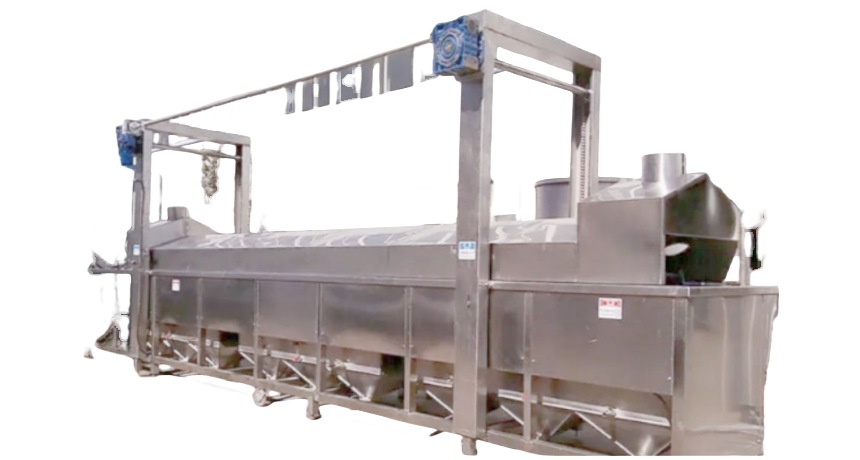
The FR-1200 fryer utilizes electric heating rather than gas. Lagos State industrial gas cylinder permitting would have added approximately six weeks to the commissioning timeline, and the site already operated a 60kVA diesel generator. Heating elements are divided into three independent zones with separate PID loops, allowing recipe selection via HMI rather than manual burner adjustment.
[The continuous frying system we supplied] required slicer modification for plantain density. The SL-300 was fitted with a slightly blunter blade edge than standard potato configuration, as plantain pulp is denser than potato flesh and an overly sharp edge compresses green plantain rather than slicing cleanly.

Site-Specific Engineering Adaptations
316L Stainless Steel for Coastal Environment
Every food-contact surface was upgraded to 316L stainless steel, with nickel content increased to twelve percent and molybdenum added at two percent. The main electrical cabinet was sealed to IP65. After eighteen months of operation, zero pitting has been observed on fryer contact surfaces.
Power Stabilization for Unstable Grid
NEPA grid supply at the site is available approximately fourteen hours daily, with generator coverage for the remainder. Voltage during generator switchover drops to 340V. An AVR and integrated soft-start module were installed in the main panel. Post-blackout restart time was reduced from eight minutes to ninety seconds, minimizing oil temperature recovery delays.
Operator Interface for Low-Literacy Workforce
The control interface was converted from text-based menus to icon-driven navigation. An oversized red mushroom-head emergency stop was installed for gloved-hand operation. Temperature recipe buttons match the green-yellow-red sorting bin color code. Operator training duration was reduced from three weeks to five days.
Installation & Commissioning Record
Equipment departed Qingdao in late January and cleared Lagos port in mid-February with SONCAP certification. Transport to Kosofe occurred on a Saturday to avoid market traffic. The warehouse roof exhibited three leak points, requiring temporary tarpaulin protection of the electrical cabinet during uncrating.
Installation required four days. Concrete floor variation of four centimeters across the fryer footprint was corrected using steel shims and quick-setting grout. During commissioning, the first production delivery of plantain arrived at a higher ripeness level than prior test samples. The fryer was initially set to the unripe recipe at 185°C. The first batch of yellow-speckled slices blackened at the edges within thirty seconds, producing smoke in the exhaust duct. The belt was stopped, the zone was drained, and temperature was reduced to 175°C. The second batch maintained acceptable color. The supplier was subsequently instructed to maintain ripeness separation per the color-coded standard.
An operator with primary-level education and no prior industrial experience required hands-on training with the HMI. On the third day, the commissioning engineer used colored markers to map the green-yellow-red system on paper. The operator achieved independent recipe switching by day five.
Operational Performance & ROI
Production Metrics
- Capacity achievement: 85% in month one, stabilizing at 98% by month three after sorting discipline was established.
- Finished yield: 74% from raw plantain to packed chips, accounting for peel, crown ends, and rejected slices.
- Oil turnover: 12% fresh oil added monthly. Plantain absorbs more oil than potato during frying, necessitating higher replenishment.
- Labor per shift: 4 workers (1 sorting/peeling, 1 slicer monitor, 1 packaging, 1 floor supervisor).
- Energy cost: NEPA grid at ₦95/kWh for approximately sixty percent of runtime; generator diesel at ₦280/kWh for the remainder. Weighted average: ₦169/kWh.
- Payback period: 10 months at 70% utilization.
Financial Analysis
At 300kg/h input and 74% yield, a single eight-hour shift at 70% utilization produces approximately 1,240 kilograms of finished chips. Packed in fifty-gram sachets at a wholesale price of ₦85 per pack to distributors serving school kiosks and Seme border traders, daily revenue less raw material, packaging film, and fuel costs generates a net margin that recovers the line investment in ten months.




Customer Feedback
“Before, we fry with charcoal at Mile 12 under umbrella. Now the gas fryer give same color every batch. NAFDAC man came last month. He said the stainless wall look proper.” — Production Supervisor, Lagos facility.
Technical Recommendations & Resources
If sourcing plantain within Lagos, specify farm-direct supply with written ripeness brackets. Market aggregators frequently mix ripe fruit to increase batch weight. Ripe plantain reduces fryer oil life by nearly one-third and darkens finished chip color.
For facilities located within fifteen kilometers of the Lagos coast, budget for 316L contact surfaces. The material premium recovers within the first year by eliminating rust-related downtime and manual frame maintenance.
 Italian
  English
  Spanish
  French
  Arabic
  Russian
  Portuguese
  German
  Indonesian
  Malay
Malay  Uzbek
Uzbek