

Potato Chips & Snack Production Lines Delivered Across Asia
We have commissioned 35+ snack production lines across 14 Asian countries, ranging from 100 kg/h semi-automatic starter plants to 1,000 kg/h fully automatic industrial facilities. Our installed base covers South Asia (India, Pakistan, Bangladesh, Nepal, Sri Lanka), Southeast Asia (Indonesia, Vietnam, Thailand, Philippines, Malaysia, Myanmar, Cambodia), and Central Asia (Kazakhstan, Uzbekistan). Every line was engineered to local raw-material specifications, electrical standards, and regulatory frameworks — not copy-pasted from a generic export catalog.
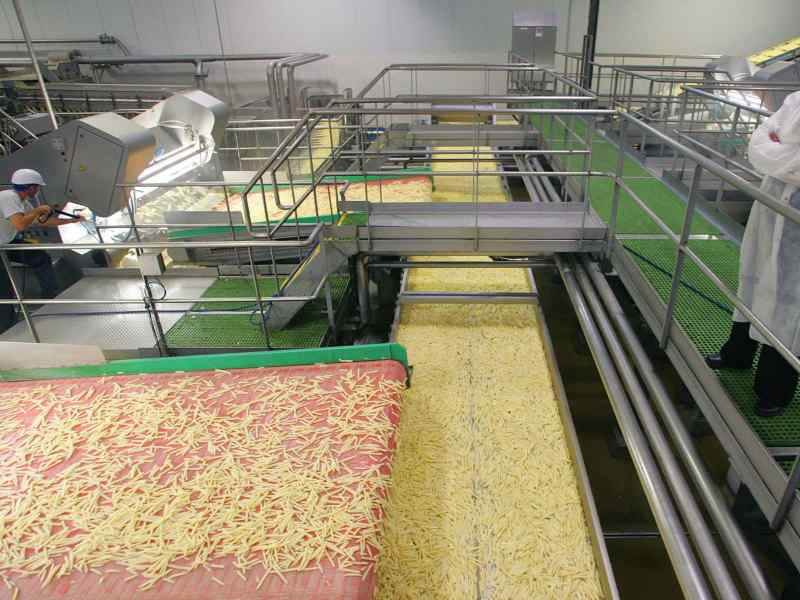
Why Asia-Specific Engineering Matters for Snack Production Lines
Exporting a European-standard frying line to Jakarta or Dhaka without adaptation is a recipe for commissioning failure. After 15 years of on-site work in Asia, we have identified five non-negotiable engineering variables that determine whether a line runs at 82% OEE or sits idle waiting for spare parts.
1. Climate Adaptation: Humidity, Condensation, and Cooling Load
Southeast Asia operates at 75-90% relative humidity year-round. Standard European electrical enclosures rated at IP54 corrode within 18 months in Ho Chi Minh City or Bangkok.
Our Asian-spec lines use IP65 electrical cabinets, stainless-steel control panels, and dehumidified MCC rooms.
For frying sections, we upsize the oil cooling loop by 15-20% to handle ambient wet-bulb temperatures that shift heat-exchanger duty cycles. In Indonesia and Thailand, this modification alone eliminated the 3-4 hour mid-shift oil-cooling downtime common on unadapted imports.
2. Raw-Material Variability: Potato, Cassava, Banana, and Compound Formulations
South Asian projects — particularly India and Pakistan — run on local table-stock potatoes with 18-22% dry matter and 0.3-0.6% reducing sugar. This demands precise two-stage blanching (90 deg C x 3-5 min, 60 deg C x 1-2 min) to prevent Maillard browning.
In contrast, Southeast Asian plants frequently process cassava, plantain, and banana — materials with entirely different starch gelatinization curves and frying windows. Our cassava line in Indonesia and banana chip line in South India use interchangeable cutting heads and variable frying temperature profiles to handle non-potato feedstock without hardware swaps.
Central Asian markets in Kazakhstan and Uzbekistan skew heavily toward compound potato chips (Pringles-type), requiring sheeting, slitting, and rotary molding modules that fresh-cut potato lines do not.
3. Electrical and Utility Standards
Asia is not electrically uniform. India operates at 415V/50Hz in many states; Bangladesh and Pakistan suffer voltage fluctuations that trip standard VFD protections.
Our lines for Bangladesh and Dhaka include AVR (automatic voltage regulation) and soft-start motor controls as standard.
In Southeast Asia, where 380V/50Hz is nominal but rural plants may receive 340V, we specify wider-tolerance transformers. All control panels are wired for 3-phase + N + PE with IEC-compliant terminal blocks, not North American NEMA configurations.
4. Halal Compliance and Material Certification
Markets in Pakistan, Malaysia, Indonesia, and Bangladesh require Halal-certified production lines. This is not a paperwork exercise. It requires dedicated oil circuits with no cross-contamination risk, stainless-steel contact surfaces (no bronze or copper in oil zones), and lubricants meeting Halal standards.
We deliver Halal compliance documentation aligned with GCC Halal and local authority requirements (JAKIM in Malaysia, MUI in Indonesia, PSQCA in Pakistan) as part of standard scope.
5. Logistics, Packaging, and Landed Cost Reality
Sea freight from China to Southeast Asian ports takes 10-14 days; to South Asia 14-18 days; to Central Asia via rail/road 18-25 days.
Equipment must be packed in ISPM-15 heat-treated plywood with vapor-barrier film to survive monsoon humidity during port delays.
Our landed-cost calculations include freight, insurance, destination THC, and customs clearance — typically adding 15-25% above EXW equipment price.
Clients in Sri Lanka and Myanmar have confirmed that our pre-shipment packing audit reduced in-transit damage from 8-12% (previous supplier) to under 2%.
Project Map — Commissioned Lines by Region & Application
Below is a filterable matrix of our commissioned projects. Each entry links to a detailed case study with technical parameters, challenges, and verified outcomes. If you are evaluating a line for a specific country or feedstock, start with the region closest to your operating environment.
South Asia: India, Pakistan, Bangladesh, Nepal, Sri Lanka
South Asia represents our highest-density installed base in Asia. Projects here range from semi-automatic 200 kg/h plants for regional brands to 1,000 kg/h industrial export facilities. Raw material is overwhelmingly local potato, but banana and compound lines are growing.
India — 500 kg/h Fully Automatic Potato Chips Production Line
Product: Fresh-cut potato chips
Capacity: 500 kg/h finished
Automation: Centralized PLC + SCADA
Key Highlight: Multi-fuel heat exchanger (natural gas/LPG/diesel) for grid-unreliable region. Commissioned with 22% EBITDA margin within 14 months.
India — 200 kg/h Semi-Automatic Potato Chips Plant
Product: Fresh potato chips
Capacity: 200 kg/h
Automation: Local switches + relay, 8-10 operators
Key Highlight: Proved viable entry point for regional brands with operator costs below USD 350/month. ROI window: 18 months.
India — Compound Potato Chips Line for Indian Snack Brand
Product: Pringles-type compound chips
Capacity: 300 kg/h
Automation: Mostly automatic
Key Highlight: Sheeting and rotary molding adapted for local potato-flour blend. Meets FSSAI and BRCGS Issue 9 audit standards.
→ View Details
India — Fresh Potato Chips Manufacturing Plant Turnkey
Product: Fresh-cut chilled fries
Capacity: 300 kg/h
Scope: Full turnkey including civil guidance, utility sizing, and operator training
Key Highlight: Shelf life: 7-10 days at 4 deg C with ascorbic acid dip.
South India — Banana Chips Processing Line
Product: Banana chips (Nendran/Plantain varietals)
Capacity: 200 kg/h
Key Highlight: Variable frying temperature profile (160-175 deg C) handles high-sugar bananas without caramelization burn.
Pakistan — 300 kg/h Fresh Potato Chips Line
Product: Fresh potato chips
Capacity: 300 kg/h
Certification: Halal-compliant oil circuit and material surfaces
Electrical: 380-415V tolerant
Pakistan — Halal Potato Chips Plant, Karachi
Product: Halal potato chips
Capacity: 500 kg/h
Key Highlight: Dedicated Halal SOP from raw material intake to packaging. Audit-ready for export to GCC markets.
Pakistan — Compound Chips Line
Product: Compound potato chips
Capacity: 200 kg/h
Key Highlight: OEM configuration with localized seasoning drum for masala and chili flavor profiles.
Bangladesh — 100 kg/h Small Scale Potato Chips Plant
Product: Potato chips
Capacity: 100 kg/h
Automation: Semi-automatic
Key Highlight: Practical floor capacity for Dhaka startup. Total project CapEx under USD 280k including civil.
Bangladesh — Mini Potato Chips Making Machine, Dhaka
Product: Potato chips
Capacity: 100 kg/h
Layout: Compact layout for 200 m² workshop
Key Highlight: Includes brush peeler, mechanical cutter, and electric single-tank blanch.
Nepal — Potato Chips Making Machine
Product: Potato chips
Capacity: 150 kg/h
Key Highlight: High-altitude calibration for steam boiler efficiency at Kathmandu elevation.
Sri Lanka — Potato Chips Production Line
Product: Potato chips
Capacity: 300 kg/h
Key Highlight: Turnkey delivery with island-specific logistics and customs clearance support.
Southeast Asia: Indonesia, Vietnam, Philippines, Thailand, Malaysia, Myanmar, Cambodia
Southeast Asia is our most diverse region in terms of feedstock. Cassava, banana, plantain, and compound chips outnumber pure potato projects. Humidity and Halal certification are the dominant engineering constraints.
Indonesia — 300 kg/h Fresh Potato Chips Production Line
Product: Fresh potato chips
Capacity: 300 kg/h
Key Highlight: Ozone wash at 0.5-1.0 ppm and ascorbic acid dip for tropical microbial control. BPOM-compliant design.
Indonesia — Cassava Chips Processing Line Turnkey
Product: Cassava chips
Capacity: 500 kg/h
Key Highlight: Peeling and washing section adapted for high-sand-content cassava tubers. Defrost interval optimized for 85% RH ambient.
Indonesia — 150 kg/h Small Scale Potato Chips Making Machine
Product: Potato chips
Capacity: 150 kg/h
Automation: Semi-automatic
Key Highlight: Entry-level plant for Surabaya SME. Brush peeler + mechanical cutter + cabinet IQF stack.
Indonesia — Automatic Potato Chips Manufacturing Plant
Product: Potato chips
Capacity: 500 kg/h
Automation: Fully automatic
Key Highlight: Centralized SCADA with Bahasa-language HMI interface.
Indonesia — Compound Potato Chips Line, Jakarta
Product: Compound chips
Capacity: 300 kg/h
Key Highlight: Sheeting line with quick-change die for 0.8-1.2 mm thickness variants. Seasoning drum at 8-12 rpm, 3-5% coating ratio.
Vietnam — 200 kg/h Potato Chips Production Line
Product: Potato chips
Capacity: 200 kg/h
Key Highlight: Dual-product changeover (potato chips + cassava chips) in 30-45 minutes.
Vietnam — Cassava Chips Manufacturing Plant, Ho Chi Minh
Product: Cassava chips
Capacity: 300 kg/h
Key Highlight: IP65 electrical enclosure and stainless-steel frame for Mekong Delta humidity.
Vietnam — Compound Chips Line OEM Project
Product: Compound chips
Capacity: 500 kg/h
Key Highlight: OEM branding configuration for Vietnamese snack exporter. Private-label seasoning system.
Vietnam — Fully Automatic Potato Chips Line, Hanoi
Product: Potato chips
Capacity: 1,000 kg/h
Automation: Fully automatic, 3-6 operators per shift
Key Highlight: Fluidized-bed IQF tunnel with variable-pitch evaporator for 18-24 hour defrost intervals.
Philippines — Banana Chips Processing Line
Product: Banana chips (Saba varietal)
Capacity: 200 kg/h
Key Highlight: Vacuum frying option at 90-105 deg C for low-oil banana chips.
Philippines — 150 kg/h Potato Chips Line, Manila
Product: Potato chips
Capacity: 150 kg/h
Key Highlight: Compact layout for urban Quezon City facility with overhead utility routing.
Philippines — Plantain Chips Plant, Cebu
Product: Plantain chips
Capacity: 200 kg/h
Key Highlight: Brush peeler calibrated for curved plantain geometry.
Thailand — Vacuum Frying Potato Chips Line
Product: Vacuum-fried potato chips
Capacity: 150 kg/h
Key Highlight: Low-temperature frying at <<100 deg C preserves color and reduces acrylamide. Oil content <<5%.
Thailand — 300 kg/h Fresh Potato Chips Plant, Bangkok
Product: Fresh potato chips
Capacity: 300 kg/h
Key Highlight: Chilled-chain packing with 7-day shelf life for Bangkok metropolitan distribution.
Thailand — Frozen French Fries Processing Line
Product: Frozen par-fried French fries
Capacity: 1,000 kg/h
Key Highlight: Full 14-stage line with IQF tunnel freezing to -18 deg C core. Export-grade for ASEAN retail.
Malaysia — Halal Potato Chips Production Line
Product: Halal potato chips
Capacity: 500 kg/h
Certification: JAKIM Halal ready
Key Highlight: Dedicated oil circuit and Halal material traceability.
Malaysia — 200 kg/h Automatic Potato Chips Plant, Kuala Lumpur
Product: Potato chips
Capacity: 200 kg/h
Automation: Mostly automatic
Key Highlight: PLC + HMI per machine, 6-10 operator crew, OEE 72-76%.
Myanmar — Potato Chips Manufacturing Plant
Product: Potato chips
Capacity: 200 kg/h
Key Highlight: Low-voltage tolerant design (340-400V) for Yangon grid conditions.
Cambodia — Fresh Potato Chips Line
Product: Fresh potato chips
Capacity: 150 kg/h
Key Highlight: Semi-automatic starter plant for Phnom Penh SME. Total CapEx USD 180-220k.
Central Asia: Kazakhstan, Uzbekistan
Central Asian markets favor compound potato chips and larger-capacity fresh-cut lines. Winter heating, EAEU certification (TR CU 021/2011), and landlocked logistics define the engineering scope.
Kazakhstan — 300 kg/h Fresh Potato Chips Line
Product: Fresh potato chips
Capacity: 300 kg/h
Key Highlight: Workshop heating integration for Almaty winter operation (-20 deg C ambient). Steam boiler oversized for space heating tap-off.
Kazakhstan — Industrial Potato Chips Plant, Almaty
Product: Potato chips
Емкость: 1,000 kg/h
Certification: EAC TR CU 021/2011 compliant
Key Highlight: Fluidized-bed IQF and hydro-cutter for 6×6/9×9 format flexibility.
Uzbekistan — 200 kg/h Fresh Potato Chips Line
Product: Fresh potato chips
Capacity: 200 kg/h
Key Highlight: Rail-freight packaging with shock-mount base for 18-day land transit.
Uzbekistan — Compound Potato Chips Plant, Tashkent
Product: Compound chips
Емкость: 300 kg/h
Key Highlight: Turnkey scope with operator training in Russian language. Seasoning system for local flavor profiles.
Technical Configuration Reference for Asian Markets
Procurement teams often ask for a quick-reference matrix to compare regional requirements. The table below is compiled from our commissioning SOPs and validated against local electrical codes, food-safety audits, and climate data.
| Dimension | South Asia | Southeast Asia | Central Asia |
|---|---|---|---|
| Typical capacity range | 200-500 kg/h (India/Pakistan); 100-200 kg/h (BD/Nepal/SL) | 150-500 kg/h (Indonesia/Vietnam/TH); 100-300 kg/h (PH/MY/MM) | 300-1,000 kg/h (KZ/UZ) |
| Dominant feedstock | Local potato (dry matter 18-22%); banana in South India | Cassava, banana, plantain, potato, compound | Compound, potato (imported flake/flour) |
| Key certification | FSSAI (India), PSQCA (Pakistan), BSTI (Bangladesh), Halal | BPOM (Indonesia), FDA (Philippines), Halal (MY/ID), Thai FDA | EAC TR CU 021/2011, Halal |
| Electrical spec | 380-415V/50Hz, 3-phase + N; AVR recommended for BD/PK | 380V/50Hz; rural areas may need 340V-tolerant transformer | 380V/50Hz; stable grid but winter heating load added |
| Climate design | Hot-season dust filtration; monsoon humidity (60-80% RH) | High-humidity IP65, corrosion-resistant panels, upsized oil cooler | Workshop heating integration, steam boiler tap-off, antifreeze drains |
| Halal requirement | High (Pakistan, Bangladesh, parts of India) | High (Malaysia, Indonesia, parts of Thailand/Philippines) | Moderate (Kazakhstan, Uzbekistan) |
| Typical landed cost uplift | +18-22% over EXW | +15-18% over EXW | +20-25% over EXW (rail/road, customs) |
| Commissioning window | 6-8 weeks (incl. visa/local permits) | 4-6 weeks (ASEAN logistics efficient) | 5-7 weeks (land transit + winter weather delays) |
CapEx & ROI Benchmarks for Asian Markets (2024–2026)
Our Asian project database shows a clear correlation between correctly sized capacity tiers and payback periods. The ranges below are based on actual invoiced project costs, not marketing estimates.
1. Entry Tier: 100–200 kg/h
Target buyers: Startups, local QSR suppliers, SME snack brands in Bangladesh, Nepal, Cambodia, and Philippines.
- Equipment EXW: USD 110k–260k
- Total project (landed + civil + utility): USD 180k–350k
- Footprint: 200–400 m²
- Crew: 6–8 operators
- Typical ROI: 14–24 months at 10–12 hr/day operation
2. Mid-Range Tier: 300–500 kg/h
Target buyers: Regional brands, export-oriented SMEs, and national distributors in Indonesia, Vietnam, Pakistan, Thailand, and Malaysia.
- Equipment EXW: USD 350k–750k
- Total project: USD 580k–1.1M
- Footprint: 600–1,000 m²
- Crew: 8–12 operators (semi-automatic) or 4–6 (mostly automatic)
- Typical ROI: 18–28 months
2. Industrial Tier: 500–1,000 kg/h
Target buyers: National brands, supermarket private-label suppliers, and industrial snack exporters in India, Kazakhstan, Thailand, and Vietnam.
- Equipment EXW: USD 800k–1.5M
- Total project: USD 1.2M–2.2M
- Footprint: 1,200–2,000 m²
- Crew: 3–6 operators per shift (fully automatic, SCADA-controlled)
- Typical ROI: 24–36 months, but EBITDA margins reach 22–28% at 300+ days/year
Critical OpEx Variables by Region
Raw potato accounts for 38–42% of revenue in South Asia where local tuber supply is strong. In Southeast Asia, cassava and banana can compress raw-material costs by 3–5 points versus imported potato flake.
Palm oil — the dominant frying medium — costs 20–30% less in Southeast Asian markets than in Central Asia or South Asia, but its price volatility requires inline filtration to extend life from 3–4 days to 12–15 days.
On a 1,000 kg/h line, this filtration upgrade alone saves USD 180,000–240,000 per year in oil replacement cost.
How We Deliver, Install, and Support Lines in Asia
On-Site Commissioning by Our Engineers
Every Asian project includes 4–6 weeks of on-site commissioning by our own mechanical and electrical engineers. We do not subcontract to local third-party installers. In India, Indonesia, and Vietnam, our teams have completed cold-start-to-commercial-production handovers with zero rework.
Language and Documentation Localization
HMI interfaces are delivered in English as standard. For Indonesia, we provide Bahasa-language screen overlays. For Central Asia, Russian-language SOPs and training manuals are available. All electrical schematics use IEC symbology, not NEMA.
Spare Parts and Remote Diagnostics
Critical wear parts — cutting blades, nylon brush rollers, conveyor belts, filter paper, and pneumatic seals — are pre-positioned in our Southeast Asian spare-parts hub. Delivery to Jakarta, Bangkok, or Ho Chi Minh City takes 7–10 days, not 4–6 weeks from China. For PLC-related faults, we perform remote diagnostics via secure VPN tunnel into the SCADA layer, resolving 60–70% of software issues without a site visit.
Post-Commissioning Audit Support
We prepare every Asian client for third-party audits. Our documentation pack includes HACCP flow diagrams, ISO 22000 prerequisite programs, BRCGS Issue 9 gap-analysis templates, and EU Regulation 2017/2158 acrylamide monitoring SOPs. Clients in Pakistan and Malaysia have passed Halal and retail audits on first attempt using our pre-prepared dossiers.
What Asian Manufacturers Say
“The 500 kg/h line in Pune paid back in 14 months. The critical factor was not the equipment price — it was the pre-shipment raw-material spec packet they sent us. We knew exactly what potato dry matter and reducing sugar to target before the containers even arrived.”
— Plant Director, Western India Snack Brand (500 kg/h fully automatic potato chips line)
“We had failed with two previous European suppliers in Jakarta because of humidity corrosion. Their IP65 cabinet and stainless-steel frame specification solved the control-panel rust issue permanently. OEE is now 78%.”
— Operations Manager, Indonesian Cassava Processor (500 kg/h cassava line)
“The Halal documentation from their engineering team was the most detailed we have received from any Chinese supplier. Our JAKIM audit passed with zero non-conformities.”
— QA Manager, Kuala Lumpur Snack Exporter (500 kg/h Halal potato chips line)
Frequently Asked Questions About Snack Production Lines in Asia
100 kg/h finished output is the practical floor for a frozen or fresh potato chip plant in Bangladesh or Nepal. Below this, fixed costs — refrigeration, packaging, QC lab, and Halal certification — do not amortize favorably. Our Bangladesh 100 kg/h plant and Nepal 150 kg/h line both validated this threshold with 14–18 month payback.
Yes. We have commissioned cassava lines in Indonesia, banana lines in South India, and plantain lines in the Philippines. The key adaptations are in the peeling section (brush roller geometry), cutting module (interchangeable heads), and frying temperature profile. Changeover between potato and cassava takes 30–45 minutes on our dual-product lines.
Yes. Halal compliance is standard scope for markets requiring it. We provide dedicated oil circuits with no cross-contamination risk, stainless-steel contact surfaces, and Halal-compliant lubricants. Our lines in Karachi, Kuala Lumpur, and Bangladesh have passed JAKIM, MUI, and GCC Halal audits.
Manufacturing takes 10–14 weeks. Sea freight to Jakarta, Bangkok, or Ho Chi Minh City is 10–14 days. On-site installation, commissioning, and training require 4–6 weeks. Total contract-to-commercial-production timeline is 20–26 weeks for Southeast Asia.
Standard configuration is 380V/50Hz, 3-phase + N + PE. For India, we support 415V/50Hz. For Bangladesh, Pakistan, and rural Southeast Asia with unstable grids, we integrate AVR and soft-start modules as standard. All motors are IEC-frame, not NEMA.
At 300 kg/h x 12 hr/day x 300 days, a line produces ~1,080 tonnes of finished chips per year. At wholesale prices of USD 1.10–1.40/kg (varies by country and format), annual revenue lands at USD 1.2–1.5M. With correct sizing and locked-in raw-material supply, EBITDA margins run 20–26%, and equipment payback is typically 18–28 months in Asian markets.
Delivery Potato Chips Production Line In Asia


 Russian
  English
  Spanish
  French
  Arabic
  Portuguese
  German
  Italian
  Indonesian
  Malay
Malay  Uzbek
Uzbek