

500kg/h Fully Automatic Potato Chips Production Line in Gujarat, India
The first time I spoke with the production director at this Gujarat-based snack company, he put it bluntly: “We are turning down orders every month because we physically cannot make enough chips.” That kind of pain drives real investment decisions. Not marketing brochures. Not trade show conversations. Just the hard reality of watching revenue walk out the door because your equipment can’t keep up.

What Brought Them to This Point
This wasn’t a startup story. The company had been in the snack business for over a decade, running two semi-automatic lines in a facility that had been expanded piecemeal over the years. They knew how to make potato chips. What they didn’t know — or rather, what they had been learning the hard way — was what happens when regional success starts pulling you into bigger markets.
Their distributors in Maharashtra had been asking for larger, more frequent shipments for almost two years. A supermarket chain in Rajasthan wanted them on shelf across forty stores. These are good problems, the kind every business owner says they want, until the problems arrive and suddenly the factory floor feels very, very small.
The breaking point came during Diwali season two years ago. Orders spiked as expected — Indian snack consumption roughly doubles during the festival period — but this time the spike didn’t come back down. It plateaued roughly 30% above the previous year’s baseline and stayed there. The company’s two small lines, running extended shifts with overtired operators, had been stretched to their absolute limit.
What the Client Actually Asked For
When we started talking specifics, three things came up repeatedly. Not feature lists. Not technical specifications. Real operational pain points.
Labor, labor, labor. Finding someone who can run a fryer properly — who knows when the oil is right, who can hear the subtle change in sound that means the slices need a few more seconds, who doesn’t wander off during a production run — is genuinely hard. Keeping that person is harder. The client had lost two experienced fryer operators in the previous eighteen months, one to a competitor and one who simply moved back to his family’s farm. Each departure disrupted production for weeks while a replacement was trained, and the replacement was never quite as good.
Predictability. The supermarket buyers didn’t care that the client’s semi-automatic lines produced inconsistent daily volumes depending on operator skill, potato variety, and ambient humidity. They cared that their shelves were full when shoppers arrived. The client had started receiving penalty clauses in supply agreements. That changes the calculus of investment pretty quickly.
Hygiene standards. Retail chains in India have been steadily tightening supplier requirements. Third-party auditors now show up with checklists covering everything from floor drainage to pest control documentation. The client’s older equipment wasn’t designed with modern food safety standards in mind. Cleaning took too long, documentation was spotty, and one failed audit could mean losing a shelf slot that took years to earn.
The budget was set, but the evaluation process stretched over several months. They visited reference sites — one in Bangalore, one in Pune, and one in Vietnam. They spoke with production managers who had been running similar equipment for two or three years. They ran the numbers on total cost of ownership, not just purchase price. By the time they made a decision, they knew exactly what they were buying and why.
Building the Line Around a Specific Number


The 500 kg/h figure didn’t come from a catalog. It came from a spreadsheet.
Monthly orders averaged 125 metric tons. Peak months pushed toward 165 tons. A 500 kg/h line running two shifts delivers between 160 and 180 tons per month. That puts the client comfortably above their current ceiling with room to absorb growth for another couple of years before needing to think about a second line.
But the capacity number only tells part of the story. The real question was: how do you configure equipment so that 500 kg/h actually translates into consistent, predictable output, not just a theoretical maximum that the line hits for twenty minutes on a good day?
The answer involved breaking the line into four distinct zones, each operating with its own independent control panel networked back to a central PLC:
The wet end — receiving hopper, destoner, washer, abrasive peeler, inspection conveyor. Everything from raw potato intake through to the point where clean, peeled tubers enter the slicer.
The middle section — high-speed slicer, starch removal system, blancher. This is where the potato becomes a chip, or at least the raw material that will become a chip after frying.
The hot section — continuous fryer with integrated oil filtration trolley, fines removal, vibrating de-oiling conveyor, seasoning drum. This is the heart of the line and where most of the engineering attention was focused.
The packaging section — two parallel multihead weighers feeding two vertical form fill seal baggers, each running at roughly 45 bags per minute.
That last decision — two packaging units instead of one — deserves a moment of attention because it captures something about how this client thinks. At 500 kg/h, fried chips pour out of the de-oiling conveyor at a rate that leaves no room for downstream delays. If packaging stops, chips pile up. Within minutes you have a bottleneck that costs real money. The incremental cost of parallel packaging modules was small. The downside risk of a single-unit failure was enormous. It was a simple risk calculation and they got it right.
One more component worth mentioning: the potato conditioning silo.
Indian potato procurement is inherently messy. Tubers arrive from different growing regions, different varieties, harvested at different times, stored under varying conditions. Sugar content varies. Dry matter varies. Chip color varies as a result. The silo sits before the washing station and allows incoming potatoes to rest for 24 to 48 hours at controlled temperature. It sounds like a small thing. It isn’t. Consistency of raw material temperature going into the fryer is one of those variables that nobody thinks about until they’ve spent a month chasing color problems that have no other explanation.
A Few Things About the Equipment Worth Knowing




The Frying System
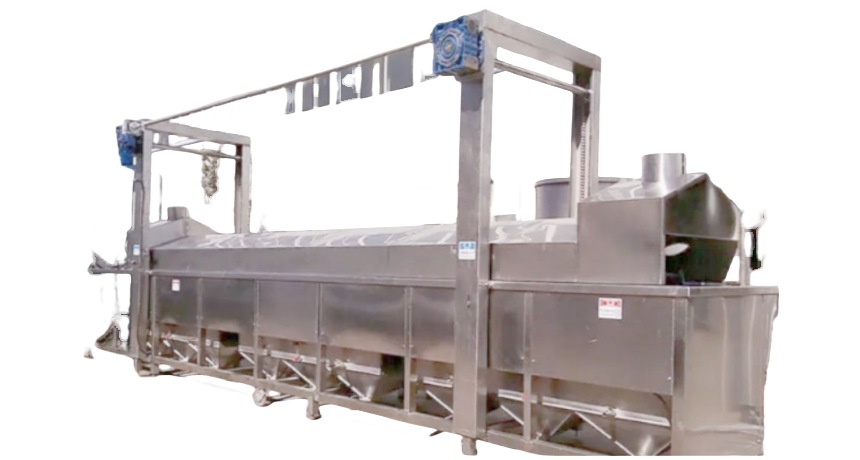
Continuous frying at 500 kg/h is a different animal from batch frying. In a batch fryer, you control quality one basket at a time. An experienced operator can compensate for potato variation by adjusting the fry time for each batch. In a continuous fryer, there’s no such thing as per-basket adjustment. Everything depends on the precision of the machine.
This fryer held oil temperature within ± 1.5°C across its full length. That number matters because even small temperature variations change frying time, which changes moisture content, which changes chip color, which changes consumer perception and complaint rates.
The oil filtration system ran continuously — stainless mesh filters and a fines removal loop that pulled carbonized particles out of circulation before they could degrade oil quality. On the client’s old batch fryers, complete oil changes were needed every 50 hours or so. With continuous filtration, the oil held usable quality for roughly 35% longer. Over a year of production, that’s a significant line item in the P&L.
The Seasoning Setup
Seasoning consistency is one of those things that consumers notice without being able to articulate. A bag that’s too light on flavor is disappointing. A bag where all the seasoning is clumped on three chips is annoying. Getting it right at 500 kg/h requires equipment that applies powder evenly, consistently, across thousands of chips per hour.
The seasoning drum operated at variable speed with injection nozzles calibrated to a target pickup of 6–8% by weight. All the parameters — drum rotation speed, powder feed rate, nozzle angle — were stored as recipes in the PLC. Switching from masala to tomato flavor took under ten minutes. The client’s quality team validated the consistency by pulling samples every hour and running weight checks.
The Controls Layer
This was something the client hadn’t specifically asked for but quickly came to value: real-time dashboards showing throughput, oil temperature profile, fryer residence time, seasoning application rate, and packaging line speed, all logged historically.
During the first month of operation, one of the operators noticed that slice thickness was drifting. It was a tiny shift — fractions of a millimeter — barely visible on individual chips but apparent in the aggregate data. Without the data logging, they might not have caught it until the moisture content started drifting as well. They caught it early, adjusted the slicer, and kept running. That’s not a dramatic story. It’s just the kind of quiet improvement that data enables.
Why We Built It This Way and Not Some Other Way
Engineering is mostly about tradeoffs. Here are the ones we made.
Why continuous frying? At 500 kg/h, running batch fryers would require five or six parallel units operating in staggered cycles. More floor space. More operators. More points of failure. And crucially, wider variation in the finished product because each batch is a unique event. Continuous frying delivers tighter residence time distribution and therefore more uniform chips. The client ran the numbers and the conclusion was clear.
Why blanch? Not every potato chips line includes a blanching step, and for good reason — it adds cost and complexity. But in this case, testing on the client’s typical potato varieties showed elevated reducing sugar levels that would cause excessive browning during frying without it. Blanching at controlled temperature leaches sugars from the slice surface. The incremental equipment cost paid for itself within the first operating year through reduced product rejection and customer returns.
Why parallel packaging? Because it’s a lot cheaper than shutting down an entire production line because a single bagger jammed. Some decisions in factory design are about optimization. This one was about paranoia. Healthy paranoia.
How the Process Actually Runs
Raw potatoes arrive in bulk, usually 20–25 ton truckloads from growing regions in Gujarat and Madhya Pradesh. They’re offloaded into the conditioning silo where temperature stabilizes for 24 to 48 hours before processing. This step, simple as it sounds, eliminated about half the color consistency problems that had plagued the client’s previous operation.
From the silo, potatoes move through a two-stage washing system: first a pre-wash tank with stone trap, then a brush washer. Two-stage washing was specified because the client’s suppliers operate in regions with heavy clay soils. Single-stage systems at the reference sites had occasionally let stones damage peeler rollers. The extra washer added modest cost and eliminated that problem entirely.
Slicing runs at 1.2 mm thickness, slightly thicker than the 1.0–1.1 mm standard in many markets. The client’s product brief called for a crunchier chip that better suits Indian consumer preferences. Thicker slices need slightly more time in the fryer — about 2 to 3 seconds additional residence time — to hit the moisture target of under 2%.
After frying, chips pass over a vibrating de-oiling conveyor. An optional air knife system activates when processing potato varieties that tend to absorb more oil. The seasoning drum follows, then transfer conveyors carry the finished chips to the packaging area.
Getting the Line Installed and Running
The production hall was a new build — roughly 1,200 square meters — in an industrial zone outside the client’s home city. The client’s contractors handled floor preparation, drainage, and utility connections to specifications provided during the engineering phase.
Equipment shipped in four containers, staggered to match the installation sequence. Heavy modules arrived first: washing station, fryer frame and pan, de-oiling conveyor. Lighter packaging modules followed a week later. Mechanical installation took eighteen days with a crew of five. Electrical and controls integration took another seven.
Power quality was a headache we anticipated. The industrial zone’s grid was not the most stable — voltage dips of up to 8% during peak demand hours were common. A voltage stabilizer and automatic transfer switch went into the electrical design as protection for the PLC and variable frequency drives. Without them, a voltage sag mid-production could have disrupted the fryer temperature loop, and that’s the kind of disruption that ruins several hundred kilograms of product before anyone notices.
Operator training happened in two phases. Phase one, during the final week of commissioning, was the basics: startup and shutdown sequences, safety interlocks, alarm response. Phase two, four weeks later, went deeper: parameter adjustment, troubleshooting, preventive maintenance scheduling tailored to the client’s production calendar. By the end of phase two, the production supervisor and three operators were running both shifts independently.
What Went Wrong and What We Did About It
I’ve never been involved in an industrial installation that went perfectly. The honest ones never do. Here’s what happened on this one.
The color mystery. About a week into production, morning-shift chips were coming out noticeably darker than afternoon-shift chips. Fryer temperature logs were clean. Oil quality was fine. It was puzzling until someone — I think it was the client’s quality supervisor — pointed out that morning potatoes were being processed straight from overnight outdoor storage, while afternoon potatoes sat in the receiving bay under a metal roof and a 35-degree sun. Temperature difference: roughly 15°C. Colder potatoes take longer to fry to the same moisture endpoint, which means more browning.
The fix was procedural, not mechanical. Potatoes now move into the conditioned holding area at least four hours before they’re scheduled. They stabilize. Color drift disappeared. This is now baked into the client’s SOP and has been for over a year.
Seasoning pickup too low. Initial runs showed seasoning pickup 1 to 1.5 percentage points below target. Drum speed and feed rate were correct. The issue turned out to be chip surface temperature at the seasoning entry point — about 5 to 8 degrees warmer than the design assumption, which reduced adhesion. Extending the cooling conveyor time by about 10% brought the surface temperature down and pickup back into range. No new equipment needed. Just calibration.
Neither of these problems was a design flaw. Both were the kind of adjustment that separates a commissioning period from a production period. Any equipment supplier who tells you their lines start up perfectly on day one is either lying or hasn’t installed many lines.
What the Numbers Actually Look Like
After a three-week stabilization period, we tracked performance across a four-week window. Here’s what the data showed.
Throughput: 3,900 to 4,100 kg of finished product per day across two shifts. Monthly output settled in around 155 to 164 tons — right where the spreadsheet had predicted.
Color consistency: Measured as standard deviation in Lab color space, color variation dropped roughly 40% compared to the client’s old batch-fried output. The client’s supermarket buyer noticed. That matters more than the number.
Moisture: Held within 0.3% of the 2.0% target. On the old lines, variation ran closer to 0.8%. Tighter moisture control means longer shelf life and fewer customer complaints about stale product.
Oil cost: Per-kilogram oil usage dropped about 22%. Continuous filtration, better temperature control, and consistent residence time all contributed. This alone covered a meaningful fraction of the line’s operating cost advantage.
Staffing: Processing and packaging went from seven operators per shift to three. The four freed staff moved to raw material inspection and QC, which were chronically understaffed and arguably more important to final product quality than anyone had previously admitted.
Uptime: Overall equipment effectiveness averaged 84% over the measurement period. The primary source of lost time was scheduled cleaning and flavor changeovers, not breakdowns.
Is This Setup Right for You?
Probably, if a few things are true.
You’re making somewhere in the range of 100 to 180 metric tons of chips per month and you’re bumping against your ceiling. You sell to supermarkets or retail chains that care about consistency and on-time delivery. You operate in a market where skilled labor is hard to find or hard to keep. And you’re thinking about total cost over a multi-year horizon, not just the purchase price.
This configuration won’t suit a startup running 50 kg batches in a rented shed. Different problem, different solution. But for a company that has already proven the market, has reliable distribution, and is held back more by production capacity than by demand — this is the kind of line that turns a bottleneck into a growth platform.
Expect a commissioning period of four to six weeks while parameters get dialed in for your specific potatoes, your specific climate, your specific product brief. Companies with prior semi-automatic experience tend to navigate this faster than first-time entrants, although turnkey project support narrows that gap considerably.
Other Cases In India
This installation is one of several potato chips production line projects we have completed across India and other international markets. Similar case studies covering semi-automatic configurations, compound chips lines, and banana chips processing projects are available for review.
 Uzbek
Uzbek  English
  Spanish
  French
  Arabic
  Russian
  Portuguese
  German
  Italian
  Indonesian
  Malay
Malay